Introduction
Humanoid robots are becoming one of the most interesting areas of modern robotics and artificial intelligence. Designed with human-like bodies, these machines can potentially walk, move their arms, recognize objects, interact with people, and perform tasks in environments created for humans.
Unlike traditional industrial robots that are usually designed for specific manufacturing tasks, humanoid robots are being developed to operate in spaces such as homes, offices, warehouses, factories, hospitals, and public environments.
Advances in artificial intelligence, computer vision, sensors, batteries, actuators, and robotics software are helping humanoid robots become increasingly capable.
Modern humanoid robots can be designed to understand instructions, recognize objects, navigate environments, manipulate items, and learn from demonstrations or data. However, their capabilities vary significantly between systems, and many remain in development or limited deployment.
This guide explains what humanoid robots are, how they work, their major types, applications, benefits, challenges, and future trends.
What Are Humanoid Robots?
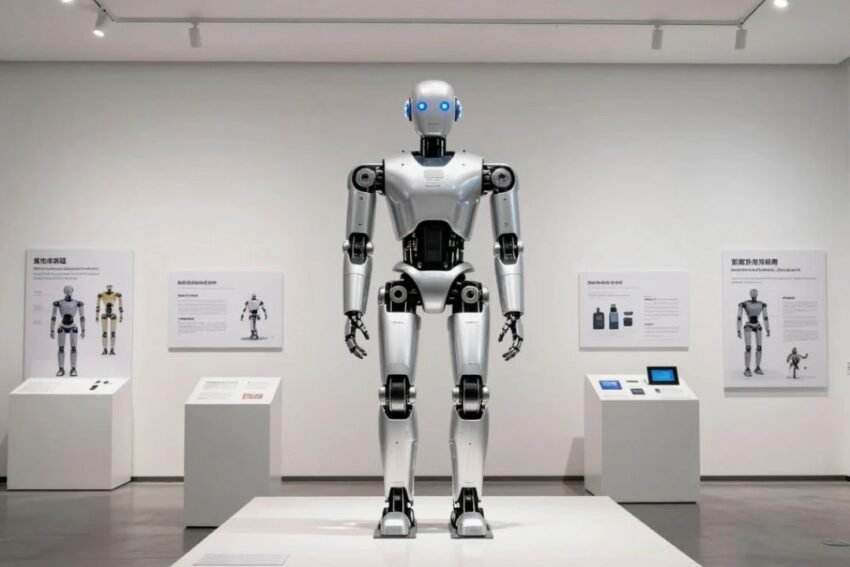
A humanoid robot is a robot designed with a body structure that resembles the human form.
A typical humanoid robot may have:
- A head
- A torso
- Two arms
- Two hands
- Two legs
- Sensors
- Cameras
- A computer system
- Battery systems
- Motors and actuators
The human-like design can allow these robots to interact with environments built for people.
For example, doors, stairs, shelves, tools, workstations, and household objects are generally designed around human body dimensions.
A humanoid robot may therefore be able to perform tasks without requiring an environment to be completely redesigned.
How Do Humanoid Robots Work?
Humanoid robots combine hardware and software to perceive their surroundings and control their movements.
Several technologies work together.
Sensors
Sensors help robots understand their physical environment.
Common sensors include:
- Cameras
- Depth sensors
- LiDAR
- Force sensors
- Touch sensors
- Position sensors
- Accelerometers
- Gyroscopes
These sensors provide information about objects, surfaces, movement, and the robot’s position.
Artificial Intelligence
AI can help humanoid robots interpret information and make decisions.
AI systems can potentially help robots:
- Recognize objects
- Understand spoken instructions
- Identify people
- Plan movements
- Navigate environments
- Manipulate objects
AI is increasingly important because robots need to respond to changing environments rather than simply repeating a fixed sequence.
Actuators and Motors
Actuators are responsible for robot movement.
They control components such as:
- Arms
- Legs
- Hands
- Head
- Fingers
- Joints
Advanced actuators can provide more precise and natural movement.
Control Systems
A robot’s control system coordinates its sensors, motors, software, and movement.
For example, when a humanoid robot walks, its control system must continuously maintain balance while coordinating its legs, body, arms, and feet.
Why Are Humanoid Robots Designed Like Humans?
The human body is a highly flexible system capable of interacting with many different environments.
Humanoid robot designs attempt to reproduce some of these advantages.
A human-like robot can potentially:
- Walk on stairs
- Use human tools
- Open doors
- Carry objects
- Work at human-height stations
- Navigate buildings
- Interact with household environments
This makes humanoid robots particularly interesting for general-purpose applications.
Types of Humanoid Robots
Humanoid robots can be categorized according to their purpose and capabilities.
Research Humanoid Robots
These robots are primarily designed for research and experimentation.
Researchers use them to study:
- Walking
- Balance
- Manipulation
- Human-robot interaction
- AI
- Motion planning
Industrial Humanoid Robots
Industrial humanoids are designed to assist with manufacturing and logistics tasks.
Potential applications include:
- Material handling
- Assembly assistance
- Inspection
- Warehouse operations
- Repetitive tasks
Service Humanoid Robots
Service robots can be designed for environments such as:
- Hotels
- Retail stores
- Healthcare facilities
- Offices
- Public spaces
They may assist with customer interaction, transportation of items, or basic service tasks.
Domestic Humanoid Robots
Domestic humanoids are intended for household environments.
Potential tasks include:
- Cleaning assistance
- Carrying objects
- Household organization
- Simple chores
- Elderly assistance
Many domestic applications remain an active area of research and development.
Humanoid Robots and Artificial Intelligence
AI is one of the most important technologies behind modern humanoid robotics.
Traditional robots often operate using carefully programmed instructions.
AI-powered humanoids can potentially use machine learning and computer vision to respond to changing situations.
For example, instead of following one fixed movement sequence, an AI-enabled robot may recognize an object, determine how to grasp it, and adjust its movement based on the object’s position.
Generative AI and multimodal AI may also help robots understand combinations of:
- Text
- Voice
- Images
- Video
- Environmental information
This could make human-robot communication more natural.
Computer Vision in Humanoid Robots
Computer vision allows robots to interpret visual information.
Cameras can help humanoid robots identify:
- People
- Objects
- Obstacles
- Doors
- Furniture
- Tools
- Work surfaces
Computer vision can also support navigation and object manipulation.
For example, a robot could identify a box on a table and use its robotic hands to attempt to pick it up.
Humanoid Robots and Machine Learning
Machine learning can help robots improve their performance through training and experience.
Robotic learning can involve:
- Demonstrations
- Simulation
- Reinforcement learning
- Imitation learning
- Sensor data
Simulation is particularly useful because robots can practice certain behaviors in virtual environments before performing them on physical hardware.
Humanoid Robots in Manufacturing
Manufacturing is one of the major areas being explored for humanoid robots.
Factories often contain repetitive physical tasks.
Humanoid robots could potentially assist with:
- Moving components
- Sorting materials
- Loading equipment
- Assembly
- Inspection
- Packaging
One potential advantage is the ability to use existing human-oriented workspaces.
However, reliability, safety, speed, maintenance, and cost remain important considerations.
Humanoid Robots in Warehouses
Warehouses contain many tasks involving movement and physical handling.
Humanoid robots could potentially help with:
- Picking items
- Moving packages
- Sorting products
- Loading containers
- Transporting materials
Their ability to operate around human-designed shelving and workstations is one reason the humanoid form is being explored.
Humanoid Robots in Healthcare
Healthcare is another potential application.
Humanoid robots could eventually assist with:
- Transporting supplies
- Delivering items
- Supporting elderly people
- Providing reminders
- Assisting with routine activities
Healthcare applications require especially high standards for safety, reliability, privacy, and human oversight.
Humanoid robots should complement healthcare professionals rather than replace professional medical judgment.
Humanoid Robots in Homes
Household environments present a difficult challenge for robots because homes contain many different objects and unpredictable situations.
Potential applications include:
- Carrying household items
- Organizing objects
- Cleaning assistance
- Kitchen assistance
- Supporting people with mobility limitations
A general-purpose home robot needs to understand a wide range of objects and situations.
This makes domestic robotics one of the more technically challenging areas.
Humanoid Robots in Education
Humanoid robots can also support education and research.
They can be used for:
- Robotics demonstrations
- Programming education
- AI research
- Human-robot interaction studies
- STEM learning
Students can use robots to learn about mechanical engineering, software development, computer vision, and artificial intelligence.
Humanoid Robots in Dangerous Environments
Robots can potentially perform tasks in environments that may be dangerous for humans.
Examples include:
- Disaster areas
- Hazardous industrial sites
- Extreme environments
- Certain inspection operations
A humanoid robot could potentially use tools and navigate spaces originally designed for people.
However, these applications require highly reliable systems.
Benefits of Humanoid Robots
Humanoid robots can provide several potential advantages.
Human-Compatible Design
Their body structure can allow them to operate in existing human environments.
Flexible Applications
General-purpose humanoids may be able to perform multiple types of tasks.
Automation
They can potentially automate repetitive physical work.
Continuous Operation
Robots do not require sleep and can potentially operate for extended periods when supported by appropriate power and maintenance systems.
Dangerous Task Assistance
Robots can potentially reduce human exposure to certain hazardous environments.
AI Integration
AI can allow robots to understand instructions and adapt to changing situations.
Challenges of Humanoid Robots
Despite rapid technological development, humanoid robots face significant challenges.
High Cost
Advanced robots require expensive hardware, sensors, actuators, batteries, and computing systems.
Battery Life
Walking and moving heavy robotic components can require significant energy.
Balance
Bipedal movement is technically difficult because the robot must continuously maintain stability.
Dexterity
Human hands are extremely capable. Reproducing similar manipulation abilities remains challenging.
Safety
Robots operating around humans must be designed with strong safety systems.
Reliability
General-purpose robots need to perform tasks consistently in unpredictable environments.
AI Limitations
AI systems can make mistakes or misunderstand instructions.
Humanoid Robots vs Traditional Robots
Traditional industrial robots are often optimized for specific tasks.
For example, a robotic arm may repeatedly perform welding or assembly.
Humanoid robots are generally designed with greater flexibility in mind.
| Feature | Humanoid Robots | Traditional Robots |
|---|---|---|
| Body design | Human-like | Task-specific |
| Environment | Human-oriented spaces | Often specialized |
| Mobility | Walking and manipulation | Usually fixed or specialized |
| Flexibility | Potentially high | Often task-specific |
| AI integration | Increasingly important | Varies |
| General-purpose use | Development focus | Less common |
Neither design is universally suitable for every application.
Businesses need to select robotic systems based on their specific requirements.
Humanoid Robots and Human Workers
Humanoid robots may change the nature of certain jobs.
They could potentially handle repetitive physical activities while humans focus on:
- Decision-making
- Creativity
- Communication
- Supervision
- Problem-solving
However, automation can also change employment requirements and create demand for new technical skills.
Organizations adopting humanoid robots will need to consider worker training, safety, job design, and responsible deployment.
Humanoid Robot Security
As humanoid robots become more connected, cybersecurity will become increasingly important.
Robots may process:
- Camera data
- Voice information
- Location information
- Operational data
- Connected application data
Security measures may include:
- Strong authentication
- Encrypted communications
- Secure software updates
- Access controls
- Network security
- Monitoring
A compromised humanoid robot could potentially create physical as well as digital risks, making security especially important.
The Future of Humanoid Robots
The future of humanoid robotics will likely depend on improvements in several areas.
Better AI
More capable AI could improve perception, planning, communication, and decision-making.
Improved Actuators
More efficient motors and actuators could improve movement and energy efficiency.
Better Batteries
Higher energy density could allow robots to operate for longer periods.
Advanced Hands
More capable robotic hands could improve object manipulation.
Improved Navigation
Better sensors and AI could help robots operate in complex environments.
Lower Manufacturing Costs
Mass production could eventually reduce the cost of humanoid robots.
Humanoid Robots in 2026 and Beyond
In 2026, humanoid robotics remains an active area of technological development.
Companies and research organizations are exploring robots for industrial, logistics, service, research, and other applications.
The industry is increasingly combining robotics with:
- Generative AI
- Computer vision
- Machine learning
- Simulation
- Cloud computing
- Edge computing
- Advanced sensors
The long-term direction is toward robots that can perform multiple tasks instead of being limited to one highly specialized operation.
However, widespread adoption will depend on whether these systems can demonstrate sufficient reliability, safety, useful capabilities, and economic value.
How Businesses Can Prepare for Humanoid Robots
Businesses interested in robotics can begin by identifying repetitive physical tasks.
A practical approach includes:
- Identify suitable workflows.
- Evaluate safety requirements.
- Measure current operational costs.
- Test robotic systems in controlled environments.
- Train employees.
- Monitor performance.
- Expand deployment gradually.
Businesses should avoid introducing robots simply because the technology is new.
The most useful applications are those where robots can solve a clear operational problem.
Conclusion
Humanoid robots represent an important direction in robotics and artificial intelligence. Their human-like form is designed to help them operate in environments originally created for people, including factories, warehouses, offices, homes, and other spaces.
Modern humanoid robots combine AI, computer vision, sensors, actuators, batteries, machine learning, and advanced control systems to understand environments and perform physical tasks.
Potential applications include manufacturing, logistics, healthcare support, education, household assistance, and dangerous-environment operations.
At the same time, major challenges remain, including cost, battery life, balance, dexterity, reliability, safety, cybersecurity, and AI limitations.
The future of humanoid robots will depend on improvements in hardware, software, AI, energy systems, and manufacturing.
As robotics technology continues to develop, humanoid robots could become increasingly useful for repetitive physical work and tasks that require interaction with human environments. Their long-term impact will depend on practical performance, affordability, safety, and how effectively humans and robots can work together.