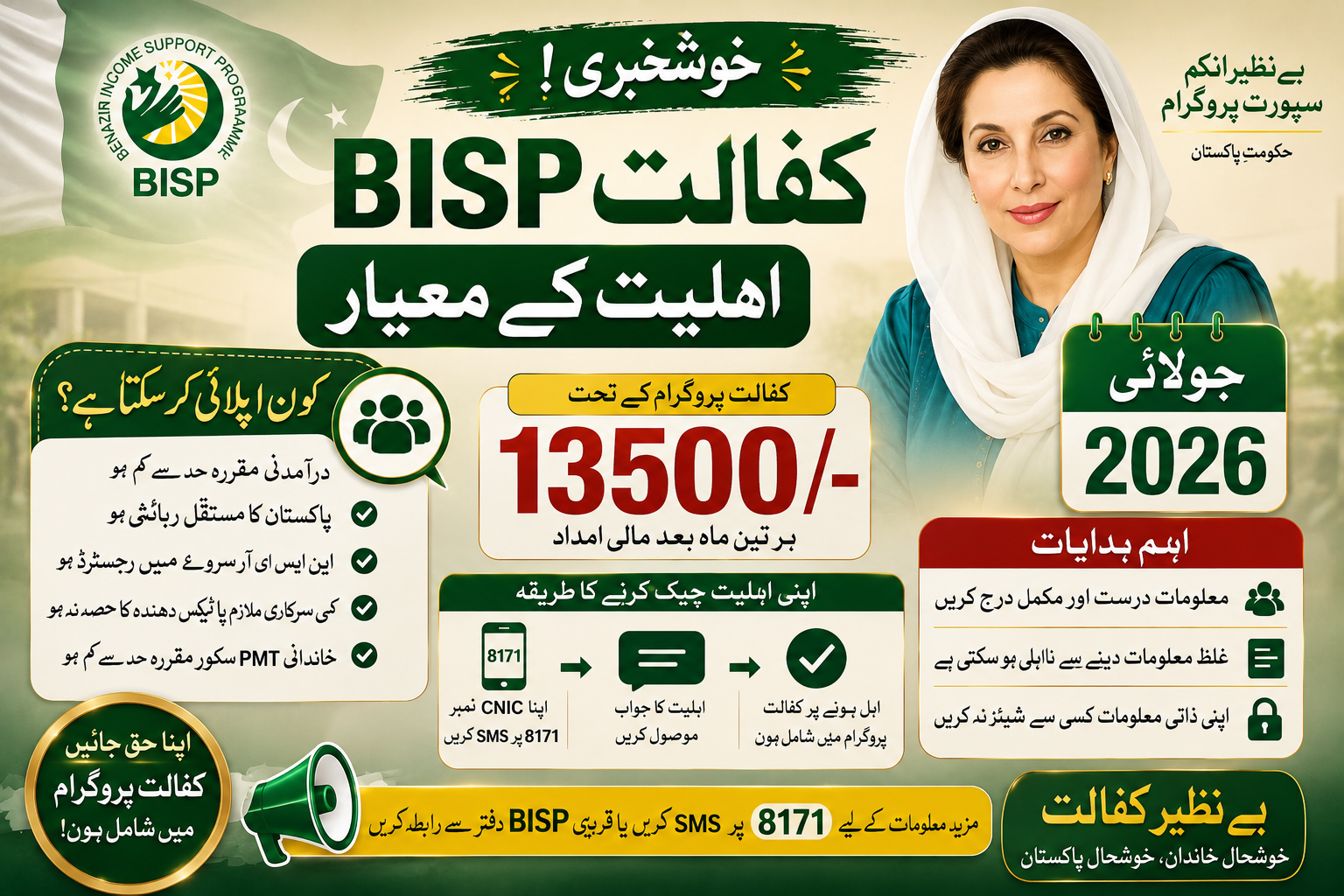
Full breakdown of BISP Kafaalat eligibility criteria 2026, including PMT score rules, required documents, and who does not qualify for the program.
Not every low-income family automatically qualifies for BISP support, and that confusion is one of the most common reasons people end up frustrated with the program. Understanding the BISP Kafaalat eligibility criteria before you apply or ask BISP staff to recheck your file can save weeks of back-and-forth. This guide lays out exactly what determines eligibility, what disqualifies a household, and what to do if your situation has changed since your last survey.
The Core Eligibility Factor: PMT Score
Everything in the BISP system flows from a single number called the PMT score, short for Poverty Means Test score. This score is calculated using data collected during the National Socio-Economic Registry survey, which looks at things like household income, number of dependents, land or property ownership, utility consumption, and overall living conditions.
A lower PMT score indicates a poorer household, and a household must fall below a specific threshold to be classified as eligible for Kafaalat. The exact cutoff has shifted over time as the government recalibrates the registry, which is why two neighboring families with seemingly similar circumstances can sometimes receive different outcomes.
Who Generally Qualifies For BISP Kafaalat Eligibility Criteria
Based on the standard criteria applied across BISP’s Kafaalat component, a household is more likely to be approved when:
- The applicant is the adult woman head of the household, since the program is structured to channel funds directly to women rather than male relatives.
- The household’s PMT score falls below the poverty threshold set during the most recent NSER survey cycle.
- The family does not have a member who is a current or recently retired government employee with a pension.
- Monthly utility costs, such as electricity and gas, fall within a modest range that reflects genuine financial hardship rather than comfortable middle-class consumption.
- The household has not already been excluded for fraud, duplicate registration, or providing false information during a previous survey.
Common Reasons Households Do Not Qualify
Many rejected applicants assume the system made an error, but in most cases one of the following applies:
- The household’s PMT score is above the cutoff, often because of land ownership, a vehicle registered in a family member’s name, or income that was not initially disclosed but later surfaced during data verification.
- A family member is employed in a government department, even in a junior role, which automatically disqualifies the household under most BISP categories.
- The survey data is outdated. If your financial situation has worsened since your last NSER visit, for example after losing a job or a health emergency draining your savings, your old score may no longer reflect reality.
- Duplicate CNIC entries or mismatched NADRA records can trigger an automatic hold until the discrepancy is manually resolved.
Required Documents
If you are applying for the first time or requesting a re-survey, BISP generally asks for:
- Your original, valid CNIC.
- CNIC or B-Form details for all dependents in the household.
- Proof of income or lack of income, where applicable.
- Utility bills, which are sometimes cross-checked against declared household expenses.
- Any documentation relevant to special circumstances, such as a death certificate for a widow applicant or a disability certificate where relevant.
Carrying photocopies in addition to originals saves time, since some Tehsil offices keep a copy on file.
How the NSER Survey Connects to Eligibility
The PMT score is not something BISP staff assign arbitrarily, it comes directly from your answers during the NSER survey. This is why providing accurate information matters more than trying to appear “more eligible” by exaggerating hardship. Inconsistent answers, such as claiming no income while owning a registered vehicle, can flag a file for manual review and delay your case significantly.
If you were surveyed years ago and your circumstances have changed, the correct step is to request a fresh Dynamic Survey update rather than waiting passively. Many families miss out simply because they assume their initial result is permanent.
Special Eligibility Categories
Beyond the standard Kafaalat criteria, certain groups receive additional consideration or fall under related sub-programs:
- Widows and divorced women are prioritized in several BISP-linked schemes, including some provincial livestock and skill development add-ons.
- Families with school-age children become eligible for the additional Taleemi Wazaif stipend on top of standard Kafaalat, provided attendance requirements are maintained.
- Persons with disabilities may qualify for separate disability-linked support cards in addition to, or sometimes instead of, standard Kafaalat depending on provincial overlap.
What to Do If You Believe You Qualify But Were Rejected
- Recheck your status through the official portal to confirm the exact rejection reason if one is shown.
- Visit your nearest Tehsil office and request a Dynamic Survey update, especially if more than a year has passed since your last survey.
- Bring updated documents that reflect any change in circumstances, such as job loss or a new dependent.
- File a formal complaint through the online system if you believe your data was recorded incorrectly during the original survey.
How Provincial Programs Interact With Kafaalat Eligibility
In recent years, several provincial governments have launched their own welfare cards and support schemes that operate alongside, rather than instead of, federal BISP support. Being enrolled in a provincial ration card or health card scheme does not automatically disqualify you from Kafaalat, since these programs are administered separately and use different criteria. However, if a provincial scheme specifically requires proof that a household is not already receiving overlapping federal support, it is worth clarifying with both offices before assuming you qualify for both simultaneously.
Why Two Similar Households Can Get Different Results
It is common for two families living on the same street, with seemingly identical income levels, to receive different eligibility outcomes. This usually comes down to small differences the PMT formula weighs heavily, such as one household owning a motorcycle registered in a family member’s name, having slightly higher recorded utility consumption, or one family member having a recorded job that the other does not. None of these factors are visible just by looking at two households from the outside, which is why eligibility differences are rarely a sign of unfair treatment.
Frequently Asked Questions
Does owning a small piece of agricultural land automatically disqualify a household? Not always, but it is one of the factors weighed in the PMT calculation, and larger or more valuable landholdings reduce the likelihood of qualifying.
Can a household reapply after being marked ineligible? Yes, through a Dynamic Survey update, particularly if circumstances have genuinely changed since the last assessment.
Is there an age requirement for the applicant? The applicant must be an adult, generally the woman head of household, though exact age requirements can vary by sub-program.
How often is the PMT score recalculated? It is updated whenever a household goes through a new NSER survey, which is not on a fixed automatic schedule unless a Dynamic Survey update is specifically requested.
Final Word
BISP Kafaalat eligibility comes down almost entirely to an honest, up-to-date PMT score. Families who feel they were unfairly excluded usually have more success requesting a fresh survey with accurate, current documentation than repeatedly checking the same old result through the portal. Treat the eligibility process less like a one-time test and more like a record that needs occasional updating as life circumstances shift.