Understand what the BISP PMT score means, how it is calculated, what counts as a good score, and how to correct a wrong score through NSER
If you have ever checked your BISP status and seen an unfamiliar number attached to your result, you have run into the BISP PMT score, the single most important figure in the entire eligibility process. Most beneficiaries have heard the term without ever having it properly explained, which leads to a lot of confusion and, sometimes, families giving up on a legitimate application simply because they misunderstood what the score actually represents.
What Does PMT Stand For
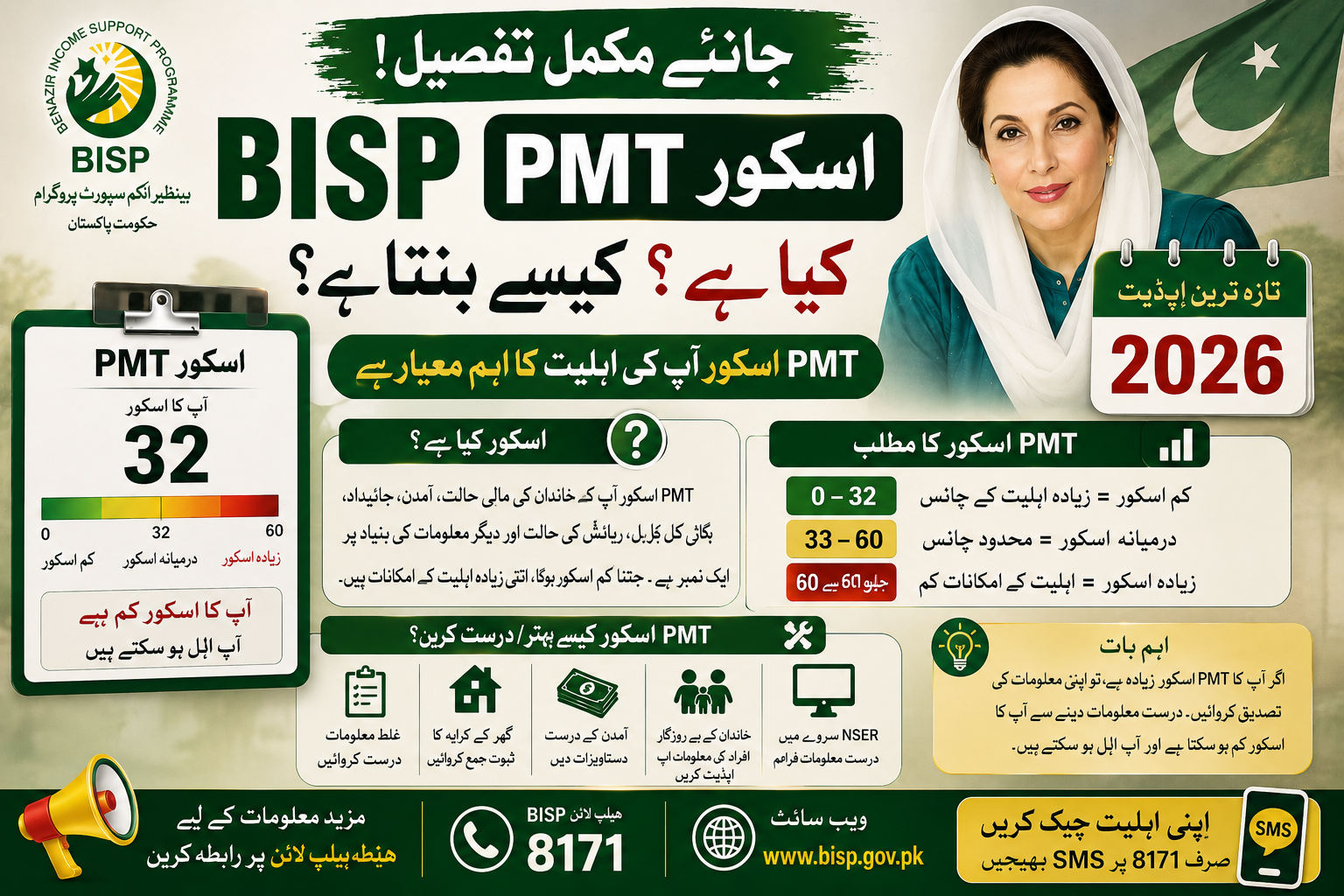
PMT stands for Poverty Means Test. It is a statistical scoring model, not a simple yes-or-no checklist, that estimates how poor a household is based on observable indicators rather than relying purely on self-reported income, which is notoriously easy to misstate either accidentally or intentionally.
The PMT score is generated using data collected during the National Socio-Economic Registry survey, commonly called NSER. A field team or digital survey form collects detailed information about a household, and that data is run through a formula that produces a single comparative score.
How the BISP PMT Score Is Calculated
While the exact internal formula is not published in full technical detail, it generally weighs a combination of factors including:
- Household size and number of dependents.
- Type of housing, including roofing material, number of rooms, and access to a private bathroom.
- Ownership of durable assets such as a refrigerator, motorcycle, or air conditioner.
- Land or property ownership.
- Utility consumption patterns, particularly electricity units used per billing cycle.
- Education level and employment status of household members.
None of these factors are assessed in isolation. A household with low reported income but several valuable durable assets may still score higher, meaning less poor, than a household with slightly higher reported income but very limited assets.
What Counts as a “Good” Score for Eligibility
In the context of BISP, a lower PMT score indicates greater poverty, and only households falling below a defined cutoff are classified as eligible for Kafaalat. The exact numeric threshold has been adjusted periodically as the government recalibrates the overall registry, so a score that qualified a household two years ago is not guaranteed to still qualify them today if the cutoff has shifted.
This is precisely why two families who feel they are in similar financial situations can receive different outcomes. The score is comparative across the entire national dataset, not an absolute measure of hardship.
Why Your Score Might Be Wrong
A surprising number of rejected applicants are not actually ineligible by income, their score is simply wrong due to a data error. Common causes include:
- Outdated information, where the survey reflects circumstances from years ago that no longer apply.
- Incorrect data entry during the original survey, such as an asset being recorded that the household does not actually own.
- A household member’s employment status changing without the record being updated.
- Confusion between household members during data collection, leading to income or assets being incorrectly attributed.
How to Check Your Current PMT Score
You can see your score classification, though not always the exact numeric value, through:
- The official BISP online portal, by entering your CNIC.
- The 8171 SMS service, which provides a basic eligibility confirmation tied to your score range.
- A direct visit to your nearest Tehsil office, where staff can pull up more detailed file information than the public-facing portal shows.
How to Correct a Wrong PMT Score
If you genuinely believe your score does not reflect your real situation, the fix is not to repeatedly check the portal hoping for a different result, it is to request a correction through the proper channel.
- Visit your nearest BISP Tehsil office in person.
- Request a Dynamic Survey update, explaining specifically what information you believe was recorded incorrectly or what has changed.
- Bring supporting documents, such as proof that a previously recorded asset has been sold, or documentation of a job loss.
- Complete the updated survey form fully and honestly, since inconsistent or incomplete answers can cause further delays.
- Ask for a reference number or receipt confirming your request was logged, so you can follow up if there is no update within a reasonable time.
How Long Correction Takes
There is no universally fixed timeline, since processing depends on regional office workload and how often batch updates are run centrally. Generally, families should expect anywhere from a few weeks to a couple of months before a corrected score reflects in the system. Checking your status periodically through the portal during this period is reasonable, but visiting the office repeatedly within just a few days of submitting a correction request rarely speeds things up.
Why the System Uses an Indirect Score Instead of Self-Reported Income
A natural question is why BISP doesn’t simply ask households to report their income directly and use that figure on its own. The answer comes down to reliability. Self-reported income in an informal economy, where many people are paid in cash, work seasonally, or have no formal payslips at all, is notoriously difficult to verify and easy to misstate, whether out of genuine confusion about monthly fluctuations or an attempt to appear poorer than the household actually is. The PMT model instead relies on harder-to-fake observable indicators, like housing material and asset ownership, which tend to correlate strongly with actual living standards even when income figures themselves are unreliable.
How the Score Compares Across Different Regions
Because living costs and typical asset ownership vary significantly between, for example, a dense urban neighborhood and a remote rural village, the underlying PMT model accounts for some regional context rather than applying one flat national standard with no adjustment at all. This is part of why a household’s score should be understood as relative to a broader statistical model rather than as a simple universal poverty line that means exactly the same thing everywhere in the country.
Frequently Asked Questions
Does a higher PMT score mean a household is doing better financially? Yes, a higher score reflects a household assessed as less poor relative to the dataset, which is the opposite of what some people initially assume.
Can I see my exact numeric PMT score online? The public portal typically shows your eligibility status rather than the precise underlying number, though Tehsil office staff can usually provide more detail in person.
If my score improves, will I lose my Kafaalat payment? If a re-survey pushes your score above the eligibility threshold, future payments can be affected, since ongoing eligibility is tied to your most recent assessment.
Is there a fee for requesting a PMT score correction? No, requesting a Dynamic Survey update through official channels is free of cost.
Final Word
The BISP PMT score can feel like an opaque number handed down from a system you cannot see inside, but it is built from concrete, correctable data points. If your score does not match your real circumstances, the right response is a documented correction request through your local Tehsil office, not repeated guesswork on the online portal. Treat the score as a living record of your household, one that genuinely changes when your real situation changes and the system is told about it.