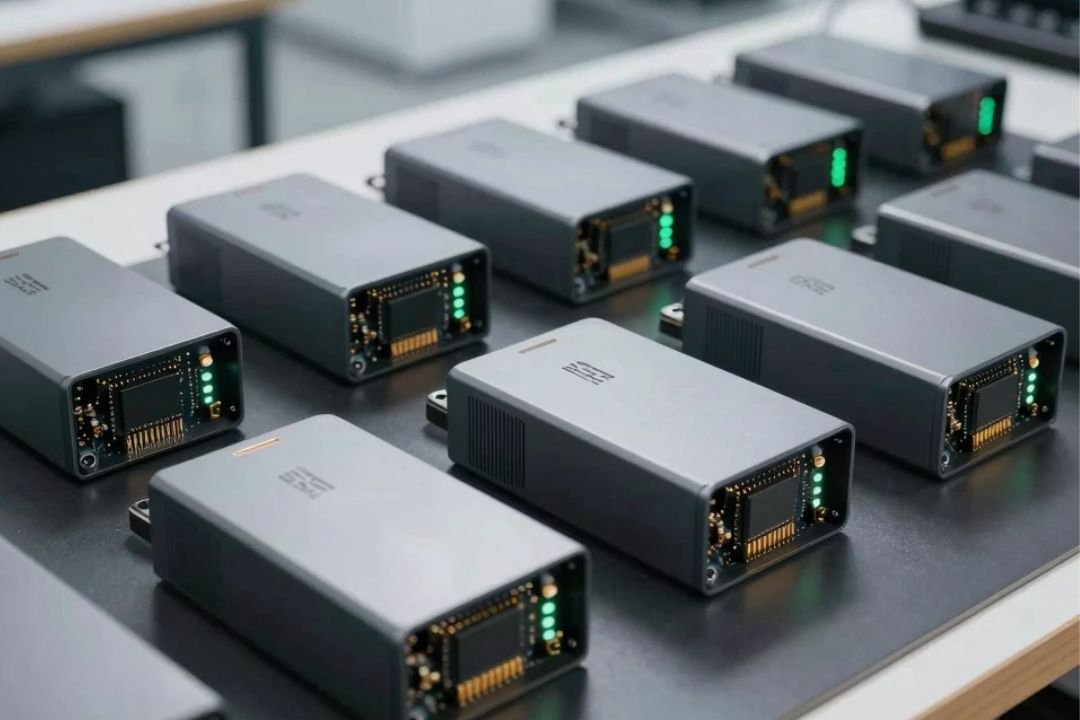
Artificial intelligence is rapidly changing the way businesses, developers, researchers, and consumers use technology. From generative AI and large language models to autonomous vehicles, robotics, computer vision, and smart devices, modern AI applications require enormous amounts of computing power. Behind these applications is a rapidly evolving category of technology known as AI hardware.
AI hardware includes GPUs, AI accelerators, neural processing units (NPUs), CPUs, specialized AI chips, high-bandwidth memory, and high-performance computing systems. These components are designed to process the massive number of calculations required by machine learning and artificial intelligence workloads.
In this guide, we will explore the world of AI hardware, GPUs, AI chips, and high-performance computing devices, explain how they work, and discuss what to consider when choosing hardware for AI applications.
What Is AI Hardware?
AI hardware refers to computer components and systems designed or optimized for artificial intelligence and machine learning workloads.
Traditional computer processors can run AI software, but modern AI applications often require much greater parallel processing capability. AI hardware is designed to accelerate mathematical operations such as matrix multiplication, tensor calculations, and other workloads commonly used by neural networks.
AI hardware can be found in:
- Desktop computers
- AI workstations
- Laptops
- Smartphones
- Data centers
- Cloud computing systems
- Robots
- Autonomous vehicles
- Industrial machines
- Edge computing devices
The purpose of AI hardware is not simply to make computers faster. It is also about improving AI performance, energy efficiency, scalability, and processing speed.
Why GPUs Are Important for Artificial Intelligence
The Graphics Processing Unit (GPU) has become one of the most important components in modern AI computing.
GPUs were originally developed to process graphics and visual effects. However, their architecture is also highly suitable for AI because GPUs can perform many calculations simultaneously.
Machine learning models often require large numbers of mathematical operations to be performed in parallel. GPUs are particularly effective at this type of workload.
GPUs are widely used for:
- Deep learning
- Neural network training
- Generative AI
- Large language models
- Computer vision
- Image generation
- Video processing
- Scientific computing
- AI inference
For many AI developers, choosing the right GPU is one of the most important hardware decisions they can make.
GPU vs CPU for AI
CPUs and GPUs have different strengths.
A CPU is designed to handle a wide variety of tasks efficiently. It is excellent for operating systems, application logic, sequential processing, data management, and general computing.
A GPU, on the other hand, is designed to handle large numbers of parallel calculations.
This difference makes GPUs particularly useful for neural networks.
A modern AI system often uses both. The CPU manages the operating system and general application processes, while the GPU handles computationally intensive AI operations.
Rather than viewing CPU and GPU as competing technologies, it is more accurate to see them as complementary components of a high-performance AI system.
What Are AI Chips?
The term AI chip generally refers to a processor designed specifically to accelerate artificial intelligence workloads.
Unlike general-purpose processors, AI chips can be optimized for operations commonly used in neural networks and machine learning.
AI chips may include:
- Neural processing units
- Tensor accelerators
- AI inference processors
- Data center accelerators
- Custom application-specific integrated circuits
- Specialized machine learning processors
The main goal of an AI chip is to perform AI calculations faster and more efficiently than a traditional processor.
Neural Processing Units (NPUs)
One of the fastest-growing categories of AI hardware is the Neural Processing Unit, or NPU.
NPUs are specialized processors designed to accelerate AI workloads while using relatively little power.
They are increasingly appearing in smartphones, tablets, laptops, and other consumer devices.
An NPU can handle tasks such as:
- Speech recognition
- Image enhancement
- Background removal
- Video effects
- Real-time translation
- AI assistants
- Facial recognition
- Local generative AI features
The major advantage of an NPU is efficiency. Instead of using the CPU or GPU for every AI task, compatible workloads can be moved to the dedicated AI processor.
This can improve performance while helping reduce power consumption.
AI Accelerators for Data Centers
Large AI models require significantly more computing power than most consumer devices can provide.
Data centers therefore use specialized AI accelerators to train and run large machine learning models.
These accelerators are designed to work with large amounts of memory and high-speed networking.
Data center AI hardware is used for:
- Training foundation models
- Running large language models
- Generative AI services
- Recommendation systems
- Scientific simulations
- Enterprise AI
- High-volume inference
Large-scale AI infrastructure may contain many accelerators working together as a single computing cluster.
The Importance of AI Memory
A powerful processor is only one part of an AI computing system. Memory is equally important.
Large AI models contain millions, billions, or even more parameters. These parameters must be stored and accessed during training and inference.
For this reason, memory capacity and memory bandwidth are critical specifications for AI hardware.
High-bandwidth memory (HBM) is commonly used in high-performance AI accelerators because it can provide extremely high data-transfer rates.
Consumer GPUs commonly use other forms of high-speed graphics memory, while AI servers may use specialized memory technologies designed for large-scale computing.
When evaluating AI hardware, it is therefore important to look beyond the number of processing cores and examine memory capacity and bandwidth as well.
AI Hardware for Generative AI
Generative AI has created enormous demand for high-performance computing.
Applications such as AI chatbots, image generators, video generation tools, coding assistants, and large language models require significant computational resources.
During model training, AI systems process huge datasets and repeatedly adjust billions of parameters. This can require large clusters of high-performance accelerators.
Inference can also require substantial computing power, especially when models are large or when thousands of users are accessing an AI service simultaneously.
Hardware optimization techniques such as quantization and model compression can reduce the resources required to run some AI models.
AI Workstations
An AI workstation is a powerful desktop computer designed for demanding workloads such as artificial intelligence, machine learning, data science, engineering, and scientific computing.
A typical AI workstation may include:
- High-performance CPU
- Dedicated GPU
- Large GPU memory
- High-capacity system RAM
- Fast NVMe SSD
- Powerful cooling system
- High-wattage power supply
AI workstations are attractive to developers because they provide local computing power without requiring continuous cloud access.
They can be especially useful for developers working with computer vision, machine learning models, generative AI, and data analysis.
AI Laptops and High-Performance Mobile Devices
AI computing is not limited to desktop computers and servers.
Modern laptops increasingly combine CPUs, GPUs, and NPUs into a single portable system.
An AI laptop can provide local processing for tasks such as:
- AI-assisted productivity
- Image editing
- Video conferencing
- Speech processing
- Coding assistance
- Content creation
- Machine learning experimentation
For professional machine learning development, a laptop with a discrete GPU may be more suitable than an NPU-only system.
However, for everyday AI applications, an NPU can provide efficient local processing without requiring the power consumption of a high-end GPU.
Edge AI Hardware
Another important development is edge AI.
Edge AI refers to processing artificial intelligence workloads close to where the data is generated instead of sending everything to a remote cloud server.
Edge AI devices are used in:
- Smart cameras
- Industrial equipment
- Robotics
- Drones
- Autonomous vehicles
- Smart home devices
- Healthcare equipment
- Retail systems
The main benefits of edge AI include low latency, reduced bandwidth requirements, and the ability to process data locally.
For example, an AI camera can analyze video locally and identify an object without continuously uploading the entire video stream to the cloud.
AI Hardware and Energy Efficiency
AI performance is not the only consideration when evaluating modern hardware.
Energy efficiency is becoming increasingly important, particularly for large data centers.
Training and operating AI models can consume substantial amounts of electricity. High-performance AI systems also produce heat, requiring sophisticated cooling infrastructure.
As a result, hardware manufacturers are increasingly focusing on performance per watt.
Energy-efficient AI hardware can help reduce:
- Electricity costs
- Cooling requirements
- Data center operating expenses
- Environmental impact
This trend is likely to become even more important as AI adoption continues to grow.
How to Choose AI Hardware
Choosing the right AI hardware depends on your specific requirements.
For AI Beginners
A modern desktop or laptop with sufficient RAM and a capable processor can be enough to start learning machine learning.
Cloud computing can provide additional GPU resources when necessary.
For AI Developers
Developers should consider a dedicated GPU, adequate VRAM, fast storage, and software compatibility.
If you work with large models, more GPU memory can be especially valuable.
For AI Researchers
Researchers working on deep learning and advanced models may need high-performance GPUs or specialized AI accelerators.
Multi-GPU systems may be necessary for particularly demanding workloads.
For Businesses
Businesses should consider performance, reliability, scalability, energy consumption, software support, and total cost of ownership.
Buying the most powerful hardware available is not always the most practical solution. The hardware should match the actual workload.
Local AI Hardware vs Cloud AI
AI workloads can be run locally or in the cloud.
Local AI Hardware
Local computing provides direct control over hardware and data. It can also be cost-effective for users who run AI workloads frequently.
Benefits include:
- Local data processing
- No recurring cloud GPU fees
- Offline operation
- Hardware control
- Predictable availability
However, local hardware requires a significant upfront investment and may have limited scalability.
Cloud AI Computing
Cloud platforms provide access to powerful GPUs and AI accelerators without requiring users to purchase physical hardware.
Benefits include:
- Flexible scaling
- Access to high-performance accelerators
- No hardware maintenance
- Easy experimentation
- Pay-as-you-go options
The main challenge is recurring cost, particularly for continuous workloads.
Many organizations use a hybrid strategy, combining local AI hardware with cloud computing.
Key AI Hardware Specifications to Watch
When comparing AI hardware, several specifications deserve attention.
GPU Performance
Higher computational performance can accelerate model training and inference.
VRAM Capacity
More GPU memory allows larger models and datasets to be processed directly on the accelerator.
Memory Bandwidth
High memory bandwidth helps move data efficiently between memory and processing units.
CPU Performance
A capable CPU is important for data processing, application management, and general computing.
NPU Performance
For laptops and smartphones, NPU capabilities can determine how efficiently local AI features operate.
Power Efficiency
Performance per watt is particularly important for mobile devices and large AI data centers.
Software Ecosystem
Hardware is only useful if the necessary frameworks, drivers, libraries, and applications support it.
The Future of AI Hardware
The future of AI hardware is likely to involve greater specialization and integration.
CPUs, GPUs, NPUs, and other accelerators will increasingly work together within the same computing platform.
We can expect continued innovation in:
- AI accelerators
- Neural processing units
- High-bandwidth memory
- Chiplet architectures
- Edge AI processors
- AI-enabled laptops
- Specialized inference chips
- Energy-efficient data centers
- Advanced AI networking
Another major trend is the movement toward on-device AI. As processors become more efficient, more AI applications will be able to operate directly on personal computers, smartphones, vehicles, and industrial equipment.
Conclusion
AI hardware is the foundation of modern artificial intelligence. GPUs provide massive parallel processing capabilities, specialized AI chips accelerate machine learning operations, and NPUs bring efficient AI processing to laptops, smartphones, and edge devices.
For data centers, powerful accelerators and high-bandwidth memory are essential for running large-scale AI models. For individual developers, AI workstations and GPU-equipped laptops can provide the computing resources needed for experimentation and development. Meanwhile, edge AI hardware is bringing intelligent processing closer to users and machines.
The best AI hardware ultimately depends on the workload. When choosing a system, consider GPU performance, VRAM, memory bandwidth, CPU capabilities, NPU performance, power efficiency, software compatibility, and scalability.
As artificial intelligence continues to evolve, AI hardware will become even more specialized and powerful. The combination of advanced GPUs, dedicated AI chips, high-performance memory, and efficient computing architectures will play a central role in making the next generation of AI applications possible.