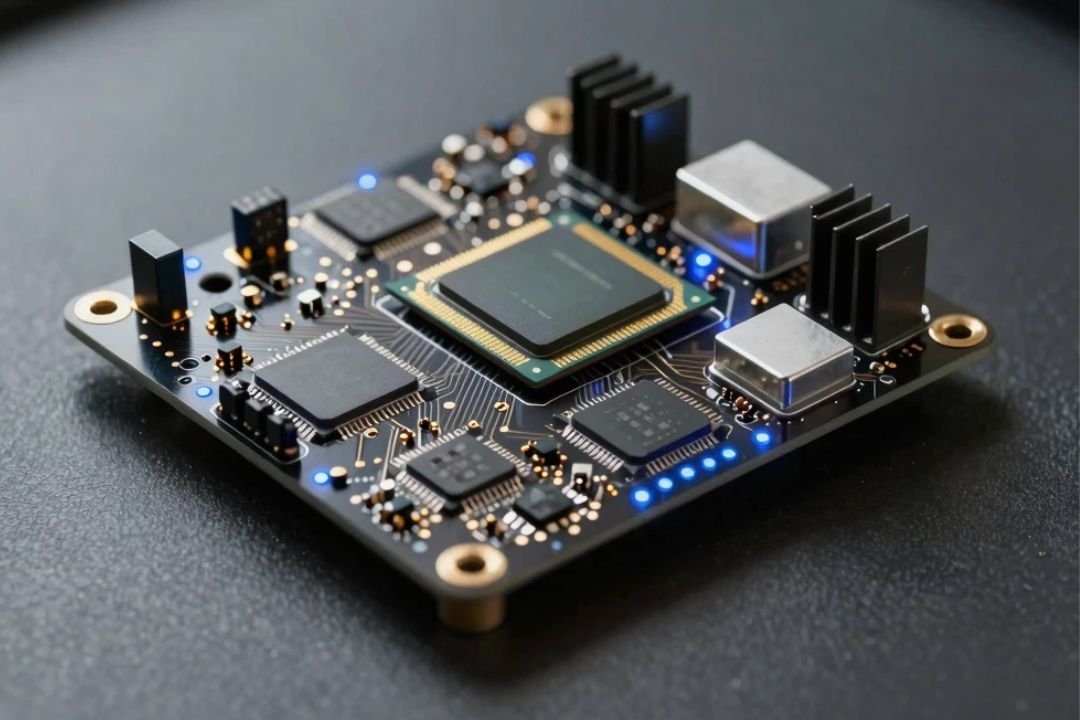
Artificial intelligence is no longer limited to cloud servers and research laboratories. Today, AI is becoming part of smartphones, laptops, cars, robots, cameras, data centers, and everyday smart devices. Behind this rapid growth is a new generation of AI hardware designed to process large amounts of data quickly and efficiently.
From powerful GPUs and specialized AI accelerators to AI PCs and edge computing devices, the hardware powering modern artificial intelligence has evolved dramatically. Choosing the right AI hardware, however, can be confusing because different chips are designed for different workloads.
This AI hardware guide explains the most important AI chips, computing devices, architectures, and technologies you should know about. Whether you are an AI developer, technology enthusiast, business owner, or simply interested in the future of computing, understanding these technologies can help you make better hardware decisions.
What Is AI Hardware?
AI hardware refers to physical computing components specifically designed to run artificial intelligence and machine learning workloads. Traditional CPUs can perform AI calculations, but modern AI applications often require much greater parallel processing performance.
AI hardware is optimized for operations such as:
- Machine learning model training
- AI inference
- Neural network calculations
- Generative AI
- Large language models (LLMs)
- Computer vision
- Speech recognition
- Robotics
- Autonomous systems
- Data analytics
The most common AI hardware includes CPUs, GPUs, NPUs, TPUs, AI accelerators, and specialized AI chips.
The primary goal is to deliver high computational performance while controlling power consumption, heat, memory usage, and overall cost.
CPU vs GPU vs NPU: Understanding AI Chips
Before selecting AI hardware, it is important to understand the difference between the major types of processors.
CPU: The General-Purpose Processor
The Central Processing Unit (CPU) is the traditional processor found in computers, servers, and smartphones. CPUs are designed to handle a wide variety of tasks and are extremely flexible.
For AI workloads, CPUs are useful for data preparation, application logic, operating system operations, and smaller machine learning models. However, they generally do not provide the same level of parallel processing performance as GPUs for large-scale AI workloads.
Modern CPUs are increasingly incorporating AI acceleration features, making them more capable of running AI applications locally.
GPU: The Powerhouse of AI Computing
The Graphics Processing Unit (GPU) has become one of the most important pieces of AI hardware. Originally developed for graphics rendering, GPUs are highly effective at performing thousands of calculations simultaneously.
This parallel architecture makes GPUs particularly useful for deep learning and neural networks.
AI researchers and developers commonly use GPUs for:
- Training large AI models
- Generative AI
- Image generation
- Computer vision
- Scientific computing
- Large language models
- AI inference
High-end GPUs can provide enormous computational performance, but they can also consume significant amounts of electricity and generate substantial heat.
NPU: AI Acceleration on Personal Devices
A Neural Processing Unit (NPU) is a specialized processor designed specifically for AI-related operations.
NPUs are becoming increasingly common in modern laptops, smartphones, tablets, and other consumer devices. Their biggest advantage is efficient local AI processing.
Instead of sending every AI task to the cloud, an NPU can handle certain workloads directly on the device.
Examples include:
- Background blur during video calls
- Face recognition
- Image enhancement
- Voice processing
- Real-time translation
- AI-powered productivity features
- Generative AI features
Because NPUs are optimized for AI workloads, they can perform these tasks with lower power consumption than relying entirely on a CPU or GPU.
AI Accelerators and Specialized Chips
AI accelerators are processors specifically designed to speed up artificial intelligence calculations. Some are general-purpose accelerators, while others are optimized for specific AI workloads.
These chips are particularly important in data centers where companies need to process massive AI workloads efficiently.
Specialized AI chips can improve:
- Processing speed
- Energy efficiency
- AI inference performance
- Data throughput
- Memory efficiency
- Total cost of ownership
As AI models become larger, specialized hardware is becoming increasingly important for maintaining reasonable performance and energy consumption.
The Importance of AI Memory
AI performance is not determined by the processor alone. Memory bandwidth and capacity are also critical.
Large AI models need to move huge amounts of data between memory and processing units. If the processor is extremely powerful but cannot access data quickly enough, the overall system can become bottlenecked.
For AI systems, important memory technologies include high-bandwidth memory (HBM), GDDR memory, and increasingly sophisticated system memory architectures.
For example, AI servers designed for large language models often require substantial memory capacity and bandwidth because model parameters can consume enormous amounts of memory.
When evaluating AI hardware, users should therefore consider both compute performance and memory specifications.
AI Hardware for Data Centers
Data centers are at the center of the modern AI revolution. Training and deploying large AI models requires enormous amounts of computing power, making specialized AI servers essential.
A modern AI server can contain multiple high-performance accelerators connected through high-speed networking and large memory systems.
Data center AI hardware is commonly used for:
- Training foundation models
- Running large language models
- Generative AI services
- Recommendation systems
- Scientific research
- Cloud AI platforms
- Enterprise analytics
One of the biggest challenges for data centers is power consumption. AI workloads can require significant electricity, so companies are increasingly focusing on performance per watt rather than raw performance alone.
AI PCs: Bringing Artificial Intelligence to Your Laptop
The rise of AI PCs is one of the biggest changes in consumer computing.
An AI PC typically includes dedicated hardware for AI workloads, such as an NPU, alongside a conventional CPU and GPU.
This allows laptops and desktop computers to run certain AI features locally.
AI PCs can support applications such as:
- AI-assisted writing
- Video conferencing enhancements
- Image editing
- Local AI assistants
- Speech recognition
- Content creation
- Real-time translation
- Security and privacy features
Local AI processing can also reduce dependence on cloud services. In some situations, this can improve responsiveness and privacy while reducing the need to upload sensitive information to remote servers.
AI Hardware for Smartphones
Smartphones have also become powerful AI computing devices.
Modern mobile processors often combine CPU, GPU, ISP, and NPU components into a single system-on-chip (SoC). This integration allows smartphones to perform sophisticated AI tasks without requiring a separate processor.
AI-powered smartphone features can include:
- Computational photography
- Object recognition
- Voice assistants
- Image enhancement
- Generative editing
- Personalized recommendations
- Translation
- Battery optimization
The challenge for smartphone manufacturers is balancing AI performance with battery life and thermal limitations.
Edge AI Devices
Not all AI computing needs to happen in a data center. Edge AI moves AI processing closer to where data is generated.
Examples include AI cameras, industrial machines, autonomous robots, smart sensors, and connected vehicles.
Edge AI provides several potential benefits:
- Lower latency
- Reduced cloud bandwidth requirements
- Faster responses
- Greater offline capability
- Improved control over sensitive data
For example, an industrial camera can analyze images locally and identify a manufacturing defect without sending every video frame to a remote server.
AI Hardware for Developers
Developers building AI applications have different hardware requirements depending on their projects.
For small machine learning projects, a modern laptop with an AI-capable processor may be sufficient.
For deep learning, computer vision, generative AI, or large language model development, a system with a powerful GPU and substantial memory may be more appropriate.
Developers should consider:
- GPU performance
- VRAM capacity
- System RAM
- Memory bandwidth
- CPU performance
- AI software compatibility
- Power consumption
- Upgrade options
Software compatibility is especially important. A theoretically powerful AI accelerator is less useful if the frameworks and libraries required by your applications do not support it effectively.
AI Hardware for Generative AI
Generative AI has dramatically increased demand for high-performance computing hardware.
Applications such as AI image generation, video generation, chatbots, coding assistants, and large language models can require substantial computational resources.
For training large models, organizations typically rely on powerful accelerator clusters. For inference, hardware requirements depend heavily on model size, optimization, quantization, batch size, and desired response speed.
Smaller optimized models can increasingly run on consumer devices, while the largest models may still require sophisticated data center infrastructure.
Power Efficiency Is Becoming More Important
Raw AI performance is only one part of the equation. Energy efficiency is becoming a major consideration.
A processor that delivers excellent performance while consuming significantly less power can reduce operating costs and simplify cooling requirements.
This is particularly important for:
- Data centers
- Laptops
- Smartphones
- Autonomous vehicles
- Edge devices
- Industrial AI systems
The concept of performance per watt is therefore becoming an important metric when comparing AI hardware.
How to Choose the Right AI Hardware
There is no single best AI chip for every application. The right hardware depends on the workload.
For everyday users, an AI PC with a capable CPU, GPU, and NPU may provide a balanced solution.
For AI developers, GPU performance, VRAM, software compatibility, and upgradeability may be more important.
For enterprises running large AI workloads, accelerator performance, memory bandwidth, networking, scalability, reliability, and energy efficiency are critical.
Before purchasing an AI computing device, consider these questions:
- What AI applications will you run?
- Do you need AI training or only inference?
- How large are your AI models?
- How much GPU memory do you need?
- Will you run AI locally or through the cloud?
- Is power efficiency important?
- Which AI frameworks and software do you use?
- Do you need a portable device or a dedicated workstation?
Answering these questions can help narrow down the hardware options.
The Future of AI Hardware
AI hardware is evolving rapidly. Future processors are likely to become more specialized, efficient, and tightly integrated.
We can expect continued development in:
- Advanced AI accelerators
- More powerful NPUs
- High-bandwidth memory
- Chiplet-based architectures
- Specialized inference processors
- AI-enabled PCs and smartphones
- Edge AI systems
- AI networking technologies
- More energy-efficient data centers
Another important trend is the movement of AI from centralized cloud infrastructure toward a combination of cloud, edge, and local computing.
Instead of processing every AI task in one location, future systems may intelligently distribute workloads across devices based on performance, privacy, latency, and energy requirements.
Conclusion
AI hardware is the foundation of modern artificial intelligence. From powerful GPUs used to train large language models to small NPUs inside smartphones and laptops, different types of processors are being designed for different AI workloads.
The most important factors to consider when evaluating AI hardware include computing performance, memory capacity, memory bandwidth, power efficiency, software compatibility, and workload requirements.
For consumers, AI PCs and smartphones are making local AI increasingly accessible. For developers, GPUs and specialized accelerators provide the performance needed for demanding machine learning applications. Meanwhile, data centers and edge devices are creating entirely new opportunities for AI-powered services and automation.
As artificial intelligence continues to expand into virtually every area of technology, understanding AI chips and computing devices will become increasingly valuable. The future of AI will not depend only on smarter software—it will also depend on faster, more efficient, and more specialized hardware capable of turning increasingly complex AI models into practical real-world applications.