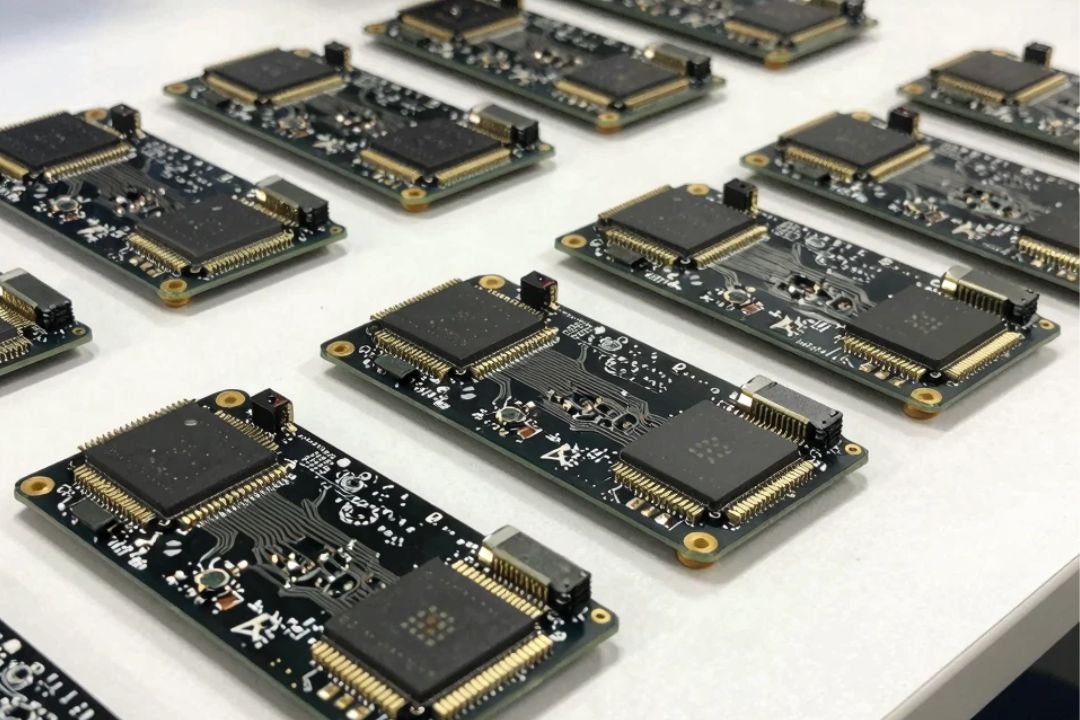
Artificial intelligence is evolving rapidly, and behind every major AI model, chatbot, autonomous system, and generative AI application is a powerful hardware infrastructure. From advanced GPUs and AI accelerators to custom processors and specialized ASICs, the AI hardware market in 2026 has become one of the most important areas of the global technology industry.
Modern AI models require enormous computing power for training, fine-tuning, and inference. As a result, companies such as NVIDIA, AMD, Intel, Google, Amazon, Microsoft, Huawei, and Alibaba are developing increasingly powerful AI chips, GPUs, CPUs, and custom AI processors.
The competition is no longer limited to traditional graphics processors. Cloud companies are designing their own AI accelerators, while chip manufacturers are improving memory bandwidth, energy efficiency, networking, and chip-to-chip communication.
What Is AI Hardware?
AI hardware refers to specialized computing components designed to process artificial intelligence workloads efficiently. These workloads include machine learning, deep learning, large language models (LLMs), computer vision, robotics, generative AI, and high-performance computing.
Traditional CPUs can execute AI workloads, but GPUs and dedicated AI accelerators are generally better suited to the massive parallel calculations required by neural networks.
The major categories of AI hardware include:
- GPUs: Highly parallel processors widely used for AI training and inference.
- AI accelerators: Specialized processors designed specifically for machine-learning workloads.
- ASICs: Application-specific chips optimized for particular AI tasks or platforms.
- CPUs: General-purpose processors that handle operating systems, data preparation, orchestration, and many AI-related workloads.
- HBM memory: High-bandwidth memory that supplies AI processors with large volumes of data at very high speeds.
- Networking and interconnects: Technologies that allow thousands of processors to work together inside AI data centers.
The importance of all these components is increasing as AI models become larger and more computationally demanding.
NVIDIA: The Center of the AI GPU Market
NVIDIA remains one of the most important companies in AI computing. Its data-center GPU platform has become a foundation for large-scale AI training and inference.
The company’s AI hardware strategy increasingly extends beyond individual GPUs to complete computing systems that combine GPUs, CPUs, high-speed networking, memory, software, and rack-scale infrastructure.
NVIDIA’s Blackwell generation has been central to the current AI infrastructure cycle, while the company’s newer Vera Rubin platform represents the next stage of its AI computing roadmap. NVIDIA is also combining its accelerators with specialized CPUs and networking technologies to create complete AI systems rather than treating the GPU as an isolated component.
The scale of demand is significant. In August 2026, AWS and NVIDIA announced plans to deploy 2 million additional NVIDIA GPUs across AWS infrastructure, illustrating the enormous amount of computing capacity being built for AI workloads.
NVIDIA’s competitive advantage also extends to its software ecosystem. CUDA, libraries, development tools, and AI frameworks make it easier for developers and organizations to build applications around NVIDIA hardware.
AMD Instinct GPUs: A Major Alternative
AMD is another major player in the AI accelerator market. Its AMD Instinct family is designed for data-center AI, high-performance computing, generative AI, training, and inference.
In 2026, AMD’s Instinct portfolio includes the MI400 series, based on the CDNA 5 architecture. AMD highlights features such as high-bandwidth memory, chiplet technology, Infinity Fabric interconnects, and support for multiple AI data types.
AMD’s approach is also closely connected to its ROCm software ecosystem. ROCm provides an alternative software foundation for organizations looking to deploy AI applications on AMD accelerators.
The company is increasingly positioning its AI portfolio as a complete infrastructure platform rather than simply selling individual GPUs. This includes GPUs, CPUs, networking, software, and rack-scale systems.
AMD’s growing role in AI is reflected in the broader semiconductor market. Reuters reported in September 2026 that AMD’s market capitalization had crossed $1 trillion amid strong investor interest in its AI business and broader computing strategy.
Google TPU: Custom AI Chips for the Cloud
Google has taken a different approach by developing its own Tensor Processing Units (TPUs).
TPUs are custom AI accelerators designed primarily around Google’s machine-learning workloads and cloud infrastructure. They are particularly important for large-scale neural-network training and inference.
Google’s latest TPU generations demonstrate how hyperscale cloud companies are increasingly developing custom silicon to optimize performance, energy consumption, and total cost of ownership.
The trend is significant because cloud providers can design chips around the exact workloads running in their data centers. Instead of relying entirely on general-purpose GPUs, companies can use specialized ASICs for specific AI applications.
Industry research indicates that custom AI accelerators are becoming a larger part of the data-center market. TrendForce projected that combined capital expenditures by eight major cloud service providers would exceed $710 billion in 2026, with AI infrastructure accounting for a major part of the investment.
Amazon Trainium: AWS Builds Its Own AI Silicon
Amazon Web Services is also investing heavily in custom AI processors through its Trainium family.
Trainium chips are designed for AI model training and inference within AWS infrastructure. Amazon’s strategy gives its cloud platform greater control over hardware, software, networking, and infrastructure costs.
Trainium3 represents a major step in AWS’s custom silicon roadmap, while Trainium4 is planned as another significant advancement in AI computing.
The growth of Trainium demonstrates a broader industry trend: cloud providers increasingly want to control the silicon underneath their AI services.
At the same time, AWS continues to work closely with NVIDIA. This means the future of AI infrastructure is not necessarily about replacing GPUs completely. Instead, cloud platforms can combine NVIDIA GPUs, custom accelerators, CPUs, and specialized networking depending on the workload.
Microsoft and Custom AI Processors
Microsoft is another major technology company developing its own AI silicon.
Its Maia family of AI accelerators is designed to support Microsoft’s cloud and AI infrastructure. Custom chips can help hyperscalers optimize workloads running across enormous data-center environments.
Microsoft’s investment in custom silicon is part of a wider industry movement in which cloud providers are attempting to reduce dependence on a single type of accelerator while improving efficiency and workload-specific performance.
The development of custom AI chips by Microsoft, Google, Amazon, Meta, and other hyperscalers has become an important part of the AI hardware market. Industry analysis in 2026 describes this as a growing custom-ASIC ecosystem involving major cloud companies and chip-design partners.
Intel and the Role of AI CPUs
Although GPUs receive most of the attention in AI discussions, CPUs remain essential to AI infrastructure.
CPUs manage operating systems, data processing, scheduling, networking tasks, storage operations, and other workloads around AI accelerators. Modern AI servers therefore commonly combine powerful CPUs with GPUs or dedicated accelerators.
Intel continues to develop processors for data centers and AI-enabled computing, while AMD has expanded its EPYC server CPU portfolio.
AMD’s latest EPYC Venice processors are an example of how CPU performance remains important even as AI accelerators receive much of the industry’s attention. Recent benchmarks released by AMD showed substantial performance improvements in selected server workloads, although benchmark configurations and compiler differences should be considered when comparing results.
This highlights an important point: AI computing is not only about GPUs. The CPU, memory, storage, networking, and accelerator must work together.
Huawei and China’s AI Chip Industry
Geopolitical restrictions and supply-chain challenges have also accelerated development of domestic AI hardware in China.
Huawei has become an important company in China’s AI semiconductor ecosystem with its Ascend accelerator family. Reuters reported in September 2026 that Huawei was seeing strong demand for its AI computing systems and was accelerating plans for newer Ascend processors. The company is also developing large-scale systems capable of connecting very large numbers of processors.
This illustrates another major trend in AI hardware: sovereign AI infrastructure.
Governments and technology companies increasingly want domestic access to AI computing resources, including processors, memory, networking, data centers, and software.
Alibaba Introduces the Zhenwu V900 AI Chip
Alibaba is also expanding its AI semiconductor efforts.
In September 2026, Alibaba introduced the Zhenwu V900, a new AI chip developed by its T-Head semiconductor unit. Reuters reported that the processor is designed for both AI training and inference and is expected to enter mass production in early 2027. Alibaba said the chip delivers roughly three times the performance of its predecessor and can be scaled into large clusters.
The announcement demonstrates how AI hardware competition is expanding geographically. The market increasingly includes American semiconductor companies, Chinese technology firms, cloud providers, startups, and specialized chip-design companies.
Why HBM Memory Is So Important for AI Chips
Processing power alone is not enough to build a fast AI accelerator.
Modern AI chips also require extremely fast memory. High Bandwidth Memory (HBM) has become a critical component because AI models continuously move enormous amounts of data between memory and compute units.
As AI processors become more powerful, memory bandwidth and capacity can become major performance limitations.
This is one reason why advanced AI hardware increasingly combines large HBM stacks with sophisticated chiplet architectures and high-speed interconnects.
The result is a system in which the processor, memory, networking, and software must be optimized together.
AI Hardware Is Moving Toward Rack-Scale Systems
One of the biggest changes in AI infrastructure is the transition from individual chips to rack-scale AI systems.
Instead of thinking about one GPU or one processor, companies are designing complete systems containing dozens or hundreds of accelerators connected through extremely fast networking.
This approach is necessary because frontier AI models can require thousands of processors working together.
Thermal management is becoming equally important. High-performance AI processors consume substantial amounts of power, creating significant cooling requirements. Industry research indicates that liquid cooling is becoming increasingly important as AI chip power consumption rises, with some advanced AI chips exceeding 1 kW of thermal design power.
Therefore, the future of AI hardware is also a story about cooling systems, power infrastructure, networking, and data-center design.
GPUs vs AI ASICs: What Is the Difference?
GPUs and ASICs serve different purposes.
GPUs are flexible and programmable. They can support many AI models and workloads, making them attractive for research, cloud computing, and rapidly changing applications.
ASICs, on the other hand, are designed for specific workloads or purposes. Their specialization can potentially deliver advantages in efficiency, performance, and cost when the workload matches the chip’s architecture.
This explains why the AI industry is increasingly using both approaches.
GPUs remain highly important for flexible AI computing, while custom accelerators are becoming increasingly attractive to companies that operate AI workloads at enormous scale.
The Future of AI Chips and Processors
The next phase of AI hardware will likely focus on several key areas:
- Higher AI compute performance
- More HBM capacity and bandwidth
- Better energy efficiency
- Faster chip-to-chip communication
- Advanced packaging and chiplet architectures
- More powerful CPUs designed for AI infrastructure
- Specialized inference processors
- Custom cloud-provider ASICs
- Improved AI software ecosystems
- Advanced liquid-cooling technologies
- Larger rack-scale AI systems
Another major development is the growing importance of AI inference.
Training a frontier model may require enormous computing resources, but once a model is deployed, millions of users can generate inference requests. This creates demand for processors optimized not just for training but also for fast, efficient, and cost-effective inference.
As AI agents, robotics, autonomous systems, and real-time applications become more common, inference hardware could become just as important as training hardware.
Conclusion
The AI hardware market in 2026 is expanding far beyond traditional graphics cards. NVIDIA continues to develop powerful GPU and full-system platforms, AMD is expanding its Instinct accelerator portfolio, Google is advancing custom TPUs, Amazon is scaling Trainium, Microsoft is developing Maia, while companies such as Huawei and Alibaba are strengthening their domestic AI chip ecosystems.
At the same time, CPUs, HBM memory, networking, advanced packaging, and cooling systems are becoming equally important parts of modern AI infrastructure.
The biggest change is that AI hardware is moving from individual processors toward complete AI computing systems. The processor is only one part of the equation; performance increasingly depends on how compute, memory, networking, software, and power infrastructure work together.
As AI models continue to grow and AI applications spread across cloud computing, enterprise software, robotics, healthcare, science, and consumer devices, demand for advanced AI chips, GPUs, processors, and accelerators is expected to remain a major force shaping the semiconductor industry.