Introduction
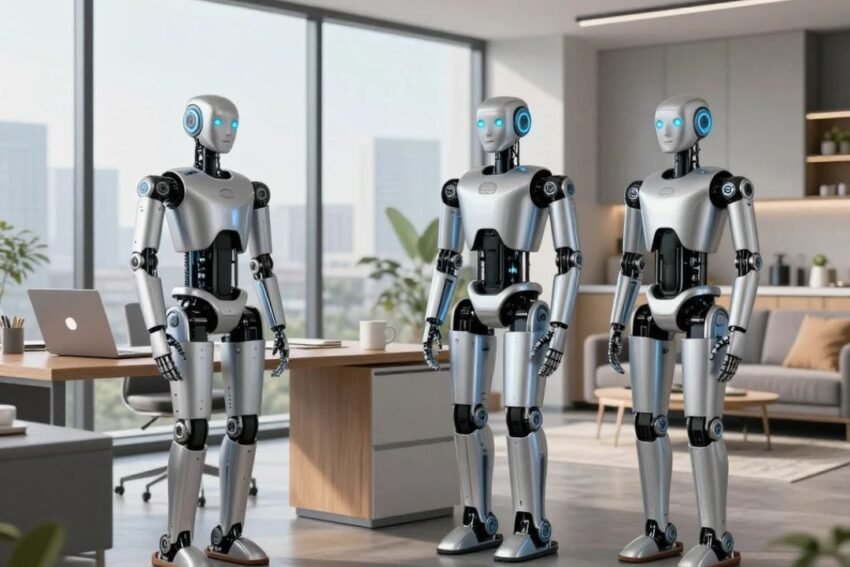
Humanoid robots in 2026 are becoming an increasingly important part of robotics and artificial intelligence research. Designed with human-like bodies, these machines are being developed to walk, manipulate objects, understand instructions, navigate environments, and perform physical tasks.
Unlike traditional industrial robots that are usually built for one specific task, humanoid robots are intended to be more flexible. Their human-like structure allows them to potentially work in environments designed for people, including factories, warehouses, offices, laboratories, and eventually homes.
The development of humanoid robots combines several technologies, including artificial intelligence, computer vision, machine learning, advanced sensors, robotic hands, actuators, batteries, and motion-control systems.
Several companies and research organizations are developing humanoid robots for different purposes. Some systems focus on industrial automation, while others emphasize general-purpose tasks, research, education, or human-robot interaction.
This guide explores some of the notable humanoid robot platforms in 2026, the technologies behind them, their potential applications, benefits, challenges, and the future of AI-powered robotics.
What Makes a Humanoid Robot Different?
A humanoid robot is designed around a human-like physical structure.
Typical features include:
- Two arms
- Two legs
- A torso
- A head
- Hands or grippers
- Cameras
- Sensors
- Motors and actuators
- Onboard computing
This design can provide an important advantage: humans have already built many environments around the human body.
Factories, warehouses, homes, offices, and stores contain:
- Stairs
- Shelves
- Doors
- Tables
- Tools
- Handles
- Storage areas
A humanoid robot may be able to interact with these environments without requiring completely new infrastructure.
1. Tesla Optimus
Tesla Optimus is one of the most widely discussed humanoid robotics projects.
The robot is being developed as a general-purpose humanoid machine with the goal of performing useful physical tasks.
Tesla’s broader expertise in artificial intelligence, computer vision, batteries, electric motors, and manufacturing provides technologies that can potentially contribute to humanoid robotics.
Optimus is designed with a human-like body and can potentially perform tasks such as:
- Object handling
- Factory assistance
- Repetitive physical work
- Material movement
One of the major ambitions behind the project is large-scale manufacturing of humanoid robots.
If humanoid robots can eventually be produced economically at scale, they could become more accessible to businesses.
2. Figure AI Humanoid Robots
Figure AI is focused specifically on general-purpose humanoid robotics.
Its robots are being developed to work in environments such as manufacturing and logistics.
Figure’s approach combines humanoid hardware with AI systems designed to help robots understand and perform physical tasks.
Potential applications include:
- Factory operations
- Warehouse work
- Material handling
- Object manipulation
- Human-robot collaboration
The company has also attracted attention for its work connecting advanced AI models with physical robotic systems.
3. Boston Dynamics Atlas
Boston Dynamics Atlas is one of the best-known advanced humanoid robot platforms.
The Atlas platform has demonstrated impressive capabilities in movement, balance, and physical manipulation.
Boston Dynamics has historically focused heavily on dynamic robotics.
Atlas development has highlighted areas such as:
- Walking
- Running
- Balance
- Object handling
- Dynamic movement
- Autonomous physical tasks
The platform demonstrates how advanced mechanical engineering and robotics software can work together.
Industrial applications are an important area of interest for humanoid robotics, particularly where robots need to move objects or operate around existing infrastructure.
4. Agility Robotics Digit
Agility Robotics Digit is a bipedal robot designed for practical work environments.
Digit has been developed with logistics and industrial applications in mind.
Potential tasks include:
- Moving containers
- Transporting materials
- Warehouse operations
- Repetitive handling tasks
Digit’s design emphasizes practical movement in structured environments.
Bipedal robots can potentially navigate spaces designed for human workers while handling repetitive physical activities.
5. Apptronik Apollo
Apptronik Apollo is another humanoid robot designed for general-purpose physical work.
The robot is being developed for applications including industrial operations.
Potential use cases include:
- Manufacturing
- Logistics
- Material handling
- Repetitive work
Apollo is designed around a human-scale form factor, which can help it operate in environments where human workers already perform tasks.
The combination of humanoid hardware and AI can potentially allow the robot to become more adaptable over time.
6. Sanctuary AI Phoenix
Sanctuary AI Phoenix is a humanoid robotics platform focused on general-purpose work.
The company has emphasized AI systems designed to help robots perform different tasks.
Potential applications include:
- Industrial work
- Retail
- Logistics
- Manufacturing
- General physical tasks
A major challenge for general-purpose robotics is teaching machines how to perform many different activities.
AI systems can potentially make this easier by allowing robots to learn from demonstrations and interact with complex environments.
7. 1X Humanoid Robots
1X is another robotics company working on humanoid and mobile robotic systems.
Its development has focused on creating robots capable of operating in human environments.
Potential applications include:
- Household assistance
- Logistics
- Industrial work
- General physical tasks
The company has explored approaches that combine physical robotics with AI-based learning.
Domestic robots are particularly challenging because homes contain many unpredictable objects and situations.
8. Unitree Humanoid Robots
Unitree is known for developing robotics platforms and has also introduced humanoid robots.
Unitree’s humanoid platforms are designed to demonstrate capabilities such as:
- Walking
- Running
- Balance
- Manipulation
- Robotics research
These systems are relevant to researchers, developers, educators, and robotics enthusiasts.
Lower-cost robotics platforms can potentially help more developers experiment with humanoid technology.
9. UBTECH Humanoid Robots
UBTECH Robotics has developed humanoid robots for research, education, service, and industrial applications.
The company’s work demonstrates the broad range of potential humanoid robotics applications.
Humanoid robots can be useful for:
- Education
- Demonstration
- Service applications
- Industrial automation
- Human-robot interaction
As robotics technology improves, different humanoid platforms may become specialized for different industries.
How AI Makes Humanoid Robots Smarter
Artificial intelligence is becoming a central component of humanoid robotics.
A modern humanoid robot may combine:
- Computer vision
- Natural-language processing
- Machine learning
- Motion planning
- Reinforcement learning
- Sensor fusion
AI can help a robot understand what is happening around it.
For example, the robot may receive an instruction to pick up an object.
The system could:
- Understand the instruction.
- Identify the object.
- Estimate its position.
- Plan a movement.
- Reach toward the object.
- Adjust its grip.
- Lift the object.
- Verify the result.
This requires coordination between AI software and physical hardware.
Humanoid Robots and Generative AI
Generative AI could significantly change human-robot interaction.
Instead of programming every task manually, people may increasingly communicate with robots through natural language.
For example:
“Please move these boxes to the storage area.”
An AI-enabled robot could potentially interpret the request and convert it into a sequence of physical actions.
This approach could make robots easier for nontechnical workers to use.
Humanoid Robots in Manufacturing
Manufacturing is one of the most important applications.
Factories contain repetitive physical activities that can potentially be automated.
Humanoid robots could assist with:
- Assembly
- Material handling
- Inspection
- Packaging
- Sorting
- Component transportation
Because factories are already designed around people, humanoid robots could potentially fit into existing workflows.
Humanoid Robots in Warehouses
Warehouses are another major area for humanoid robotics.
Potential tasks include:
- Moving packages
- Picking products
- Sorting inventory
- Restocking shelves
- Transporting containers
Robots could potentially work alongside existing warehouse systems.
AI could also help them adapt when objects or environments change.
Humanoid Robots for Home Use
Domestic humanoid robots remain a challenging but potentially transformative application.
A household robot could eventually assist with:
- Carrying objects
- Cleaning
- Organizing items
- Kitchen assistance
- Basic household chores
However, homes are less predictable than factories.
Objects can be placed in different locations, rooms can become cluttered, and tasks can change from day to day.
For this reason, reliable domestic humanoids require highly capable AI and physical manipulation systems.
Humanoid Robots in Healthcare
Humanoid robots could potentially assist healthcare facilities with nonmedical physical tasks.
Examples include:
- Transporting supplies
- Delivering objects
- Supporting routine logistics
- Assisting with certain mobility-related activities
Healthcare environments require strong safety, privacy, and reliability standards.
Robots should support trained professionals rather than replace professional medical judgment.
Humanoid Robots and Education
Robotics platforms can also provide valuable educational opportunities.
Students can learn about:
- Artificial intelligence
- Programming
- Mechanical engineering
- Computer vision
- Machine learning
- Robotics
Humanoid robots can provide practical demonstrations of how software interacts with physical systems.
Key Technologies Behind Humanoid Robots
Several technologies work together to create modern humanoid systems.
Sensors
Sensors provide information about surroundings and robot movement.
Cameras
Cameras support computer vision and object recognition.
Actuators
Actuators control physical movement.
AI Processors
Computing hardware processes AI models and sensor information.
Batteries
Batteries provide power for movement and computation.
Robotic Hands
Hands allow robots to interact with physical objects.
Control Software
Control systems coordinate movement, balance, perception, and task execution.
Benefits of Humanoid Robots
Humanoid robots offer several potential benefits.
Flexible Automation
They may perform multiple tasks instead of one specialized operation.
Human-Compatible Design
They can potentially work in spaces created for people.
Productivity
Humanoids may automate repetitive physical activities.
Worker Support
Robots can assist employees with physically demanding tasks.
Dangerous Work
Robots may eventually perform some tasks in hazardous environments.
Continuous Operation
Robots can potentially work for extended periods with appropriate charging and maintenance.
Challenges of Humanoid Robots
The technology also faces significant challenges.
High Costs
Advanced humanoids require expensive components.
Battery Limitations
Energy consumption can restrict operating time.
Safety
Robots need sophisticated systems to work safely around people.
Dexterity
Human-like hand movement remains difficult to reproduce.
Reliability
Robots must work consistently in unpredictable environments.
AI Errors
AI systems can misunderstand instructions or make incorrect decisions.
Maintenance
Physical machines require regular maintenance and repairs.
How to Choose a Humanoid Robot
Organizations evaluating humanoid robots should consider:
- Intended application
- Robot mobility
- Payload capacity
- Manipulation capabilities
- Battery life
- AI capabilities
- Safety systems
- Software integration
- Maintenance requirements
- Total cost
A robot designed for warehouse operations may have different requirements from one designed for research or household assistance.
The Future of Humanoid Robots
The humanoid robotics industry is likely to continue evolving.
Future systems may feature:
- More capable AI
- Better robotic hands
- Improved batteries
- Faster processors
- More efficient actuators
- Better balance
- Improved navigation
- Natural-language interaction
- More autonomous task execution
One of the biggest developments could be the combination of large AI models and physical robotics.
AI models may increasingly help robots understand goals while specialized robotics systems translate those goals into physical actions.
Are Humanoid Robots Ready for Everyday Life?
Humanoid robots have made significant technological progress, but widespread everyday adoption is still developing.
Industrial environments may be easier for robots because they are more structured.
Homes are much more unpredictable.
For humanoid robots to become common household assistants, they will need to become:
- Safer
- More reliable
- More affordable
- More energy-efficient
- Better at manipulation
- Easier to control
Consumer trust will also be important.
Conclusion
The best humanoid robots in 2026 represent a rapidly developing combination of robotics and artificial intelligence. Platforms from companies such as Tesla, Figure AI, Boston Dynamics, Agility Robotics, Apptronik, Sanctuary AI, 1X, Unitree, and UBTECH demonstrate different approaches to humanoid machine development.
These robots are being explored for manufacturing, logistics, research, education, service applications, and potentially household assistance.
The biggest technological opportunity comes from combining AI with advanced robotic hardware. Computer vision, natural-language processing, machine learning, sensors, actuators, and robotic hands can help humanoid machines understand their surroundings and perform increasingly complex tasks.
However, humanoid robotics still faces major challenges involving cost, battery life, safety, reliability, dexterity, cybersecurity, and AI performance.
As these challenges are addressed, humanoid robots could become increasingly useful in workplaces and eventually in everyday environments.
The future of humanoid robotics is likely to focus on practical usefulness rather than appearance alone. The most valuable robots will be those that can safely, reliably, and efficiently perform real-world tasks while working alongside humans.