Introduction
Robots are becoming an important part of modern technology, manufacturing, logistics, healthcare, research, and automation. However, not all robots are designed in the same way. Humanoid robots and traditional robots use many of the same fundamental technologies, but their physical designs, capabilities, applications, and operating environments can be very different.
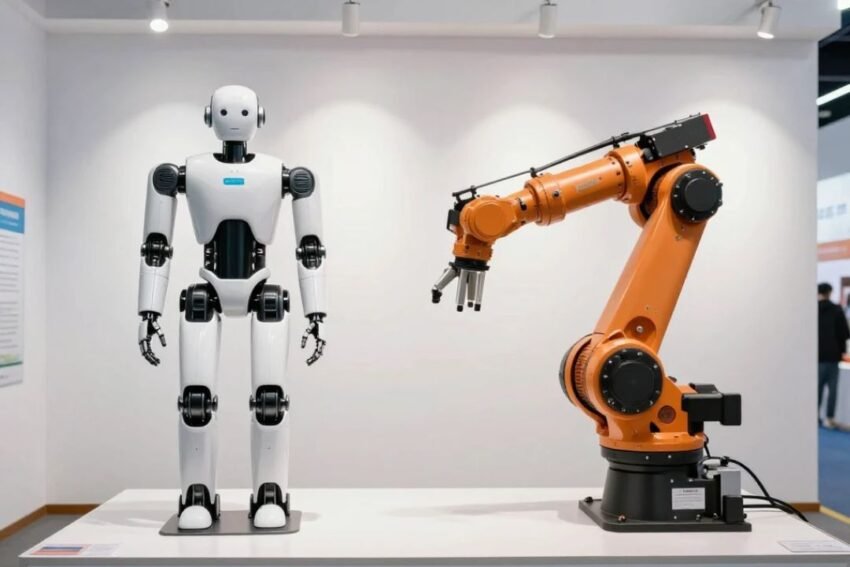
Traditional robots are often built to perform specific tasks. They may use robotic arms, wheels, tracks, specialized tools, or fixed mechanical systems. Humanoid robots, on the other hand, are designed around a human-like body with features such as two arms, two legs, a torso, and sometimes human-like hands.
The main reason for developing humanoid robots is flexibility. Human environments already contain stairs, doors, shelves, tools, vehicles, workstations, and other structures designed for people. A robot with a human-like body could potentially interact with these environments without requiring major modifications.
This guide explains humanoid robots vs traditional robots, including their key differences, benefits, applications, technologies, limitations, and future potential.
What Are Humanoid Robots?
Humanoid robots are machines designed to resemble the human body.
A humanoid robot may include:
- A head
- A torso
- Two arms
- Two legs
- Hands
- Cameras
- Sensors
- Motors
- Artificial intelligence systems
- Batteries
The exact design varies between robots.
Some humanoid robots focus primarily on research and movement, while others are being developed for industrial automation, logistics, service applications, or general-purpose tasks.
The human-like design is intended to provide flexibility when operating in environments designed for humans.
What Are Traditional Robots?
Traditional robots include a broad range of robotic systems that are not necessarily human-shaped.
Examples include:
- Industrial robotic arms
- Automated guided vehicles
- Autonomous mobile robots
- Robotic welding machines
- Pick-and-place robots
- Warehouse robots
- Agricultural robots
- Inspection robots
- Medical robotic systems
Traditional robots are often optimized for specific applications.
For example, a robotic arm in a factory can be designed to repeatedly perform welding, painting, assembly, or material-handling operations.
This specialized design can make traditional robots highly effective for specific workflows.
Humanoid Robots vs Traditional Robots: Key Difference
The most obvious difference is physical design.
Humanoid robots attempt to reproduce aspects of human movement and body structure.
Traditional robots can use whatever shape is most efficient for their intended task.
A wheeled robot may be better than a humanoid robot for moving quickly across a flat warehouse floor.
A robotic arm may be better for repetitive assembly.
A humanoid robot may be useful when the task requires walking, reaching, manipulating objects, and operating in human-oriented spaces.
Comparison Table
| Feature | Humanoid Robots | Traditional Robots |
|---|---|---|
| Body structure | Human-like | Task-specific |
| Mobility | Usually bipedal | Wheels, arms, tracks, or fixed |
| Flexibility | Designed for multiple tasks | Often specialized |
| Environment | Human-oriented environments | Often optimized environments |
| AI | Increasingly important | Varies by system |
| Dexterity | Human-like hands in some systems | Specialized tools or grippers |
| Cost | Often high | Varies widely |
| Main focus | General-purpose automation | Task-specific automation |
Neither category is suitable for every situation.
The appropriate choice depends on the task, environment, cost, safety requirements, and desired level of flexibility.
1. Physical Design
Humanoid robots are designed to resemble people.
Their two-legged structure allows them to potentially navigate stairs, narrow areas, and human workspaces.
Traditional robots use different designs depending on their applications.
An industrial robot arm, for example, does not need legs because it may remain attached to a fixed platform.
A warehouse mobile robot may use wheels because wheels can provide efficient movement on smooth floors.
2. Mobility
Mobility is a major difference between the two categories.
Humanoid robots generally use two legs.
Bipedal walking requires sophisticated balance and control systems.
Traditional mobile robots often use wheels or tracks.
Wheeled systems can be highly efficient on appropriate surfaces.
Humanoid walking is more complex, but it may provide access to environments where wheels are less suitable.
3. Task Flexibility
Humanoid robots are being developed with general-purpose tasks in mind.
A humanoid could potentially:
- Pick up objects
- Carry items
- Use tools
- Open doors
- Walk between workstations
- Move materials
Traditional robots are often optimized for a smaller set of tasks.
This specialization can be an advantage when a business needs high-speed, repetitive automation.
4. AI Capabilities
Artificial intelligence is becoming increasingly important for humanoid robots.
AI can help robots:
- Understand instructions
- Recognize objects
- Navigate environments
- Plan actions
- Learn behaviors
- Adapt to changing situations
Traditional robots can also use AI.
For example, an autonomous warehouse robot may use computer vision and machine learning to navigate around obstacles.
The difference is not that humanoid robots use AI while traditional robots do not. Instead, humanoid robotics often places greater emphasis on combining AI with general-purpose physical interaction.
5. Human Environment Compatibility
One of the biggest potential advantages of humanoid robots is compatibility with human environments.
Most buildings are designed around people.
They contain:
- Stairs
- Doors
- Tables
- Chairs
- Shelves
- Tools
- Handles
A humanoid robot can potentially use the same infrastructure.
Traditional robots may require specialized environments.
For example, a warehouse might need dedicated paths for autonomous mobile robots.
6. Dexterity and Manipulation
Humanoid robots can use human-like hands or advanced robotic grippers.
This can allow them to potentially manipulate a wide range of objects.
Traditional robots often use specialized end-effectors.
A factory robot may have a welding tool, suction system, clamp, or specialized gripper.
This can make traditional robots extremely effective for repetitive industrial applications.
7. Manufacturing Applications
Traditional robots have been widely used in manufacturing for decades.
Common applications include:
- Welding
- Painting
- Assembly
- Packaging
- Inspection
- Material handling
Humanoid robots are being explored for additional manufacturing tasks where flexible movement may be useful.
They could potentially move between different workstations and perform tasks that would otherwise require human workers.
8. Warehouse Applications
Traditional warehouse robots are already used for various logistics tasks.
These systems can transport products, move shelves, or deliver materials.
Humanoid robots may provide additional flexibility for tasks involving human-designed shelving and workstations.
Potential applications include:
- Picking
- Sorting
- Carrying packages
- Loading materials
- Restocking
The practical value depends on speed, reliability, cost, and integration with warehouse systems.
9. Healthcare Applications
Traditional robots are already used in certain healthcare applications, including surgical assistance, rehabilitation, transportation, and laboratory automation.
Humanoid robots could potentially support healthcare workers with:
- Transporting supplies
- Delivering items
- Assisting with routine physical activities
- Supporting elderly people
Healthcare environments require strict safety and privacy standards.
Robots should be deployed carefully and with appropriate professional oversight.
10. Household Applications
Humanoid robots have attracted attention because they could potentially perform tasks in homes.
Potential activities include:
- Carrying objects
- Cleaning assistance
- Organizing items
- Kitchen support
- Basic household chores
Traditional robots are already common in some household applications.
Robot vacuum cleaners are a simple example.
They are highly specialized but can efficiently perform one task.
A humanoid robot aims for a much broader range of capabilities.
11. Cost Comparison
Cost is an important consideration.
Traditional robots can range from relatively simple systems to highly sophisticated industrial machines.
Their cost depends on:
- Hardware
- Sensors
- Software
- Payload
- Precision
- Installation
- Maintenance
Humanoid robots can be expensive because they require many complex systems simultaneously.
These include:
- Legs
- Arms
- Hands
- Sensors
- Batteries
- AI processors
- Balance systems
- Advanced control software
Large-scale manufacturing could potentially reduce humanoid robot costs over time.
12. Energy Efficiency
Energy requirements also differ.
Wheeled robots can be highly efficient when operating on flat surfaces.
Humanoid robots must continuously manage balance and move multiple joints while walking.
This can require substantial energy.
Advances in batteries, motors, actuators, and software optimization may improve humanoid robot efficiency.
13. Safety Challenges
Safety is critical for both types of robots.
Traditional robots can operate in controlled areas where workers are separated from machines.
Humanoid robots are more likely to operate directly alongside people.
They therefore need advanced safety features such as:
- Collision detection
- Force sensing
- Emergency stops
- Human tracking
- Movement controls
- Obstacle detection
Safe human-robot collaboration will be essential for widespread adoption.
14. Maintenance and Reliability
Robots need regular maintenance.
Traditional industrial robots can benefit from predictable operating conditions.
Humanoid robots have many moving joints and complex components.
Their maintenance requirements could include:
- Battery replacement
- Motor servicing
- Sensor calibration
- Software updates
- Mechanical inspection
- Component replacement
Reliability will be one of the most important factors determining whether humanoid robots can compete with specialized automation.
Benefits of Humanoid Robots
Humanoid robots offer several potential benefits.
Flexible Tasks
They can potentially perform multiple types of physical work.
Human-Compatible Environments
They may operate in spaces designed for people.
General-Purpose Automation
A single robot could potentially perform different tasks.
Natural Interaction
AI may allow people to communicate with robots using natural language.
Workforce Assistance
Humanoids could assist employees with repetitive or physically demanding activities.
Benefits of Traditional Robots
Traditional robots also provide important advantages.
Specialization
They can be optimized for specific tasks.
Efficiency
Specialized systems can perform repetitive operations quickly.
Precision
Industrial robots can provide highly repeatable movements.
Established Technology
Many traditional robotic systems have already been deployed extensively.
Lower Complexity for Specific Tasks
A simple robot designed for one job may not need the complex hardware required by a general-purpose humanoid.
Challenges of Humanoid Robots
Major challenges include:
- High development costs
- Battery limitations
- Complex balance control
- Difficult manipulation
- Safety requirements
- AI errors
- Maintenance
- Reliability
Humanoid robots must demonstrate clear economic value before widespread commercial adoption.
Challenges of Traditional Robots
Traditional robots also have limitations.
They may:
- Require specialized infrastructure
- Perform only specific tasks
- Have limited flexibility
- Need reprogramming for new workflows
- Struggle outside controlled environments
However, specialization can also be an advantage.
Which Robot Is Better for Businesses?
There is no universal answer.
Businesses should evaluate the specific task.
A traditional robot may be appropriate when:
- The task is repetitive
- The environment is controlled
- High precision is required
- The workflow is predictable
- Specialized equipment is acceptable
A humanoid robot may be useful when:
- Multiple tasks are required
- The environment is designed for humans
- Flexible movement is important
- Existing tools need to be used
- Physical tasks change frequently
The decision should be based on measurable operational requirements rather than the novelty of the technology.
The Future of Humanoid and Traditional Robots
The future may not be about one type of robot replacing another.
Instead, different robotic systems may work together.
A smart factory could potentially use:
- Humanoid robots for flexible physical tasks
- Robotic arms for precision assembly
- Mobile robots for transportation
- AI software for planning
- Sensors for monitoring
- Humans for supervision and complex decisions
This combination could create highly automated environments.
AI and the Future of Robotics
Artificial intelligence may become increasingly important across both humanoid and traditional robotics.
Future systems could use AI for:
- Computer vision
- Task planning
- Natural-language interaction
- Predictive maintenance
- Navigation
- Object manipulation
- Autonomous decision-making
The integration of AI could make robots more adaptable.
Conclusion
Humanoid robots vs traditional robots is not simply a competition between two types of machines. They represent different approaches to automation.
Traditional robots are often designed around specific tasks and can provide high precision, efficiency, and reliability in controlled environments. Humanoid robots are designed to provide greater flexibility and potentially operate in environments created for humans.
Humanoid robots could become useful in manufacturing, logistics, healthcare support, household assistance, and other areas where general-purpose physical automation is valuable.
Traditional robots will continue to play an important role because specialized machines can be highly efficient for predictable tasks.
The future of robotics will likely include a combination of humanoid robots, industrial robots, mobile robots, AI systems, and human workers.
As artificial intelligence, sensors, batteries, actuators, and robotics software improve, humanoid robots may become increasingly capable.
The most important factor will not be whether humanoid or traditional robots are universally better. It will be whether a particular robotic system can perform a specific task safely, reliably, efficiently, and economically.