Introduction
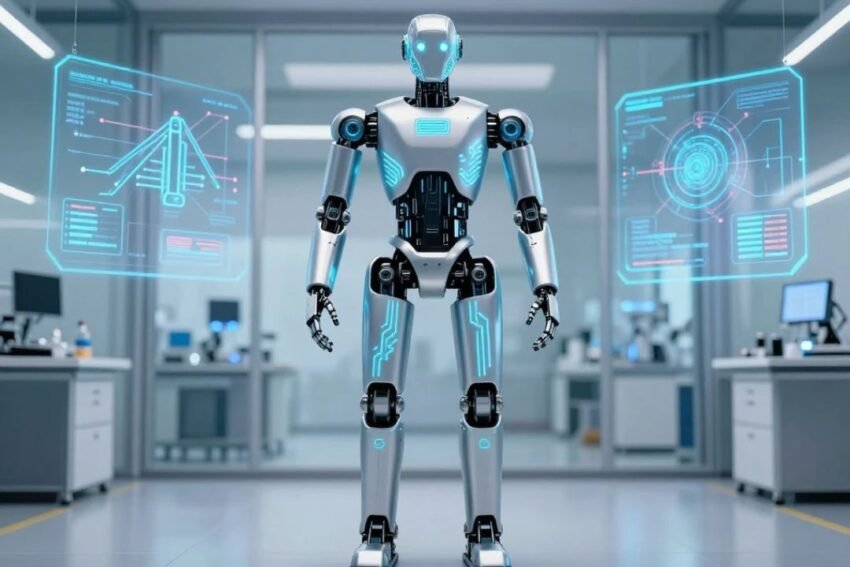
The future of humanoid robots is becoming one of the most exciting areas of artificial intelligence and robotics. Humanoid robots are designed to perform physical tasks using a body structure that resembles the human form, including arms, legs, a torso, and advanced sensors.
For decades, robots have primarily been designed for specialized applications. Industrial robotic arms, automated vehicles, warehouse machines, and other robotic systems can perform specific tasks with high precision. Humanoid robots represent a different approach: creating flexible machines capable of operating in environments originally designed for humans.
Advances in artificial intelligence, machine learning, computer vision, batteries, actuators, robotics software, and sensors are making this goal increasingly practical.
Future humanoid robots could potentially work in factories, warehouses, hospitals, offices, homes, laboratories, and hazardous environments. They may assist humans with repetitive physical work, understand natural-language instructions, and adapt to different situations.
However, major challenges remain. Humanoid robots need to become safer, more reliable, more affordable, more energy-efficient, and better at manipulating objects.
This guide explores the future of humanoid robots, including AI-powered robotics, automation, human-robot collaboration, industrial applications, home robots, smart machines, emerging technologies, benefits, challenges, and long-term opportunities.
What Is the Future of Humanoid Robotics?
The future of humanoid robotics is focused on creating machines that can perform a broader range of physical tasks.
Instead of designing one robot for one specific job, developers are working toward more flexible robotic platforms.
Future humanoids could potentially:
- Understand spoken instructions
- Recognize objects
- Navigate buildings
- Walk across different surfaces
- Pick up and manipulate objects
- Use human tools
- Learn new tasks
- Work alongside humans
- Complete multi-step workflows
The goal is not necessarily to perfectly reproduce every ability of a human.
Instead, the objective is to build useful machines that can perform practical tasks in human environments.
1. Artificial Intelligence Will Power Humanoid Robots
Artificial intelligence is likely to become one of the most important technologies behind future humanoid robots.
AI can help robots process information from cameras and sensors and turn that information into actions.
Future AI-powered robots may become better at:
- Object recognition
- Speech understanding
- Navigation
- Planning
- Decision-making
- Task execution
- Learning
Instead of following only fixed instructions, robots could potentially understand the overall objective and determine how to achieve it.
2. Generative AI and Humanoid Robots
Generative AI could make robots much easier for humans to interact with.
A person may eventually be able to give a robot a natural-language instruction such as:
“Please organize these items and put them on the shelf.”
The robot could potentially identify the objects, understand the destination, plan a sequence of movements, and execute the task.
Generative AI can also help robots interpret descriptions, images, instructions, and environmental information.
This could create a more natural interface between people and machines.
3. AI Agents Will Enable Multi-Step Robotics
Agentic AI may play an important role in the next generation of humanoid robots.
An AI agent can be designed to pursue a goal through multiple steps.
For robotics, this could mean:
- Understand a goal.
- Create a plan.
- Identify required objects.
- Navigate to the correct location.
- Perform physical actions.
- Check the outcome.
- Adjust the plan if necessary.
This approach could make humanoid robots more autonomous.
However, physical-world AI requires additional safety controls because mistakes can have physical consequences.
4. Better Computer Vision
Future humanoid robots will need highly capable computer vision.
Vision systems may help robots understand:
- Objects
- People
- Surfaces
- Obstacles
- Tools
- Rooms
- Workstations
Advanced vision models can potentially help robots understand not only what an object looks like but also how it might be used.
For example, a robot could identify a cup, determine its location, estimate its orientation, and plan a grasp.
5. More Advanced Robotic Hands
Robotic hands remain one of the biggest challenges in humanoid robotics.
Humans can manipulate thousands of different objects with relatively little effort.
Future robotic hands may become:
- More flexible
- More precise
- More sensitive
- Stronger
- Better at delicate tasks
Touch and force sensors could help robots understand how much pressure they are applying.
Improved hands could significantly expand the range of tasks humanoid robots can perform.
6. Better Walking and Balance
Future humanoids will need reliable mobility.
Walking requires continuous adjustments to maintain balance.
Robots must account for:
- Foot placement
- Body position
- Surface conditions
- Obstacles
- External forces
- Movement speed
Advances in AI-based motion control and better actuators could help humanoid robots walk more naturally and safely.
Future robots may become better at navigating:
- Stairs
- Uneven surfaces
- Narrow spaces
- Crowded areas
- Outdoor environments
7. Advanced Robot Actuators
Actuators control robotic movement.
Future actuators are likely to focus on:
- Higher efficiency
- Greater strength
- Better precision
- Lower weight
- Improved durability
Better actuators could make humanoid robots faster, stronger, and more efficient.
They could also improve movement quality and reduce energy consumption.
8. Longer-Lasting Batteries
Battery technology is another major factor in the future of humanoid robotics.
Humanoid robots need energy for:
- Walking
- Lifting
- Computing
- Sensors
- Communication
- AI processing
Future batteries could provide higher energy density while reducing weight.
Better energy management could also help robots operate for longer periods between charging sessions.
9. Humanoid Robots in Smart Factories
Smart manufacturing is likely to be an important market for humanoid robots.
Future factories may combine:
- Humanoid robots
- Industrial robotic arms
- Autonomous vehicles
- AI
- IoT sensors
- Cloud computing
- Data analytics
Humanoid robots could potentially perform flexible tasks while specialized robots handle highly repetitive operations.
This could create mixed automation environments in which different machines perform different roles.
10. Humanoid Robots in Warehouses
Warehouses are another promising area.
Future humanoid robots could potentially:
- Pick products
- Move boxes
- Sort inventory
- Load materials
- Restock shelves
- Transport packages
Because warehouses are generally designed around human workers, humanoid robots may be able to interact with existing infrastructure.
AI could also help them respond to changing inventory and working conditions.
11. Humanoid Robots in Healthcare
Healthcare applications may expand as robotic technology becomes safer and more reliable.
Humanoid robots could potentially assist with:
- Transporting medical supplies
- Moving equipment
- Delivering items
- Supporting routine logistics
- Assisting elderly people
They could reduce some physical workloads for healthcare workers.
However, medical environments require strong safety, privacy, and reliability controls.
Robots should support healthcare professionals rather than replace professional judgment.
12. Humanoid Robots for Elderly Assistance
An aging global population could increase interest in assistive robotics.
Humanoid robots may eventually help older adults with selected daily activities.
Potential functions include:
- Carrying objects
- Providing reminders
- Assisting with household tasks
- Fetching items
- Supporting mobility-related routines
These applications require careful attention to safety, dignity, privacy, and user control.
13. Humanoid Robots in Homes
The home could eventually become an important environment for humanoid robots.
Unlike factories, homes are highly unpredictable.
A household robot may need to understand:
- Different furniture
- Multiple rooms
- Small objects
- Pets
- People
- Changing layouts
- Unexpected obstacles
Future AI systems could make robots better at handling these environments.
However, affordability and safety will be critical for consumer adoption.
14. Human-Robot Collaboration
The future of robotics is likely to involve humans and robots working together.
Robots could handle:
- Repetitive lifting
- Transportation
- Routine physical tasks
- Hazardous operations
Humans could focus on:
- Creativity
- Communication
- Complex decisions
- Supervision
- Problem-solving
This collaborative model could allow organizations to benefit from automation while maintaining human control.
15. Natural-Language Interaction
Natural-language interaction may become a standard feature of future humanoid robots.
Instead of programming a machine manually, users could communicate with it through speech.
For example:
“Bring the box from the storage area.”
The robot could interpret the request and potentially complete the task.
Voice interaction could make robots more accessible to nontechnical users.
16. Simulation and Digital Twins
Simulation will likely play a major role in robot development.
Developers can create virtual environments where robots practice tasks before performing them in the real world.
A digital twin can represent a physical environment or system digitally.
Robotic simulation can help developers test:
- Walking
- Manipulation
- Navigation
- Factory workflows
- Safety scenarios
This can reduce some physical testing requirements and accelerate development.
17. Edge AI for Real-Time Robotics
Humanoid robots require fast responses.
Edge computing can allow AI processing to happen closer to the robot rather than sending every piece of information to a remote server.
Potential advantages include:
- Lower latency
- Faster decisions
- Reduced network dependence
- Better privacy
- More reliable operation
Edge AI could therefore become an important part of autonomous humanoid systems.
18. Cloud Robotics
Cloud computing can complement onboard processing.
Robots could potentially use cloud systems for:
- Model updates
- Data analysis
- Fleet management
- Remote monitoring
- Training
- Shared knowledge
A fleet of robots could potentially learn from collective operational data, subject to appropriate privacy and security controls.
19. Smarter Robot Learning
Future robots may become better at learning new tasks.
Instead of requiring engineers to manually program every action, robots could potentially learn through:
- Human demonstrations
- Video examples
- Simulation
- Reinforcement learning
- AI-generated instructions
This could reduce the effort required to deploy robots across different environments.
20. Humanoid Robots and Dangerous Work
Robots may increasingly be used for tasks that present safety risks to humans.
Potential applications include:
- Hazardous inspections
- Disaster response
- Industrial maintenance
- Dangerous environments
- Remote operations
Humanoid robots could be particularly useful when environments already contain equipment designed for people.
Humanoid Robots and Automation
Humanoid robotics could become part of a larger automation ecosystem.
Future businesses may combine robots with:
- AI agents
- Workflow automation
- IoT
- Digital twins
- Cloud computing
- Computer vision
- Industrial software
This could allow physical work to become connected with digital business processes.
For example, an AI system could identify a warehouse requirement and assign a humanoid robot to complete the physical task.
Benefits of Future Humanoid Robots
The development of humanoid robots could provide several advantages.
Flexible Automation
Humanoids may perform multiple tasks using the same platform.
Existing Infrastructure
They can potentially operate in human-designed environments.
Worker Assistance
Robots could help with physically demanding activities.
Dangerous Task Support
They may reduce human exposure to hazardous environments.
Productivity
Automation could reduce the time required for repetitive physical work.
Natural Interaction
AI could allow users to communicate with robots through ordinary language.
Challenges of Future Humanoid Robots
The technology also faces important challenges.
High Cost
Sophisticated humanoids require advanced hardware and software.
Battery Life
Mobile robots need substantial energy.
Safety
Robots must operate safely around people.
Reliability
Machines need to perform consistently in unpredictable environments.
Dexterity
Human-level manipulation remains difficult.
Cybersecurity
Connected robots can introduce new digital security risks.
Privacy
Robots may collect video, audio, location, and environmental data.
Regulation
Governments and organizations may need new standards for physical AI systems.
Economic Impact of Humanoid Robots
Humanoid robots could affect many industries.
Businesses may use them to automate repetitive physical activities.
This could change workforce requirements and create new demand for skills such as:
- Robotics engineering
- AI development
- Robot maintenance
- Automation management
- Cybersecurity
- Data analysis
Organizations may also need employees who can supervise and collaborate with robotic systems.
The Future of Humanoid Robots and AI
The strongest development may come from combining advanced AI with capable physical machines.
AI can provide perception, reasoning, language understanding, and planning.
Robotics hardware provides movement and interaction with the physical world.
Together, these technologies can create systems capable of both understanding information and taking physical action.
This could represent an important step toward more general-purpose automation.
How Businesses Can Prepare
Businesses interested in humanoid robotics can begin by identifying repetitive physical workflows.
A practical strategy includes:
- Identify suitable tasks.
- Evaluate safety requirements.
- Calculate potential costs and benefits.
- Test robots in controlled environments.
- Train employees.
- Establish security policies.
- Monitor performance.
- Expand successful applications gradually.
Companies should focus on practical business problems rather than adopting robotics simply because it is a new technology.
Conclusion
The future of humanoid robots will depend on the continued development of artificial intelligence, robotics hardware, batteries, sensors, actuators, computer vision, and automation software.
Humanoid robots could eventually perform a broad range of tasks in factories, warehouses, healthcare facilities, homes, offices, and hazardous environments. AI agents and generative AI may make these machines easier to communicate with while helping them plan and execute multi-step activities.
At the same time, significant challenges remain. Safety, reliability, cost, energy consumption, dexterity, cybersecurity, privacy, and regulation will all influence how quickly humanoid robots become widely adopted.
The most important development may be the convergence of AI and physical robotics. Intelligent software can help machines understand goals, while advanced hardware allows them to interact with the real world.
As these technologies mature, humanoid robots could become valuable assistants for both businesses and individuals.
The next generation of robotics is likely to focus not simply on creating machines that look human, but on creating intelligent, useful, safe, and adaptable robots that can work effectively alongside people.